Worldview Recursive Compression
How to Better Encompass Your Worldview with AI
📘 Want the complete guide?
Learn more: Read the full eBook here →
Your AI keeps suggesting chatbots because that’s what average internet advice recommends. You know better. You just haven’t told it—properly.
If you’ve spent years developing expertise in your field, you’ve probably noticed something frustrating about AI: despite its impressive capabilities, the outputs feel… generic. Surface-level. Like advice from a competent but inexperienced junior consultant who’s read a lot of blog posts but hasn’t done the work.
This isn’t a model problem. It’s a worldview problem.
And the fix isn’t better prompting or waiting for the next model upgrade. It’s compiling your worldview into frameworks that patch the model’s stale, generic reasoning with your hard-won domain expertise.
The Stale Worldview Problem
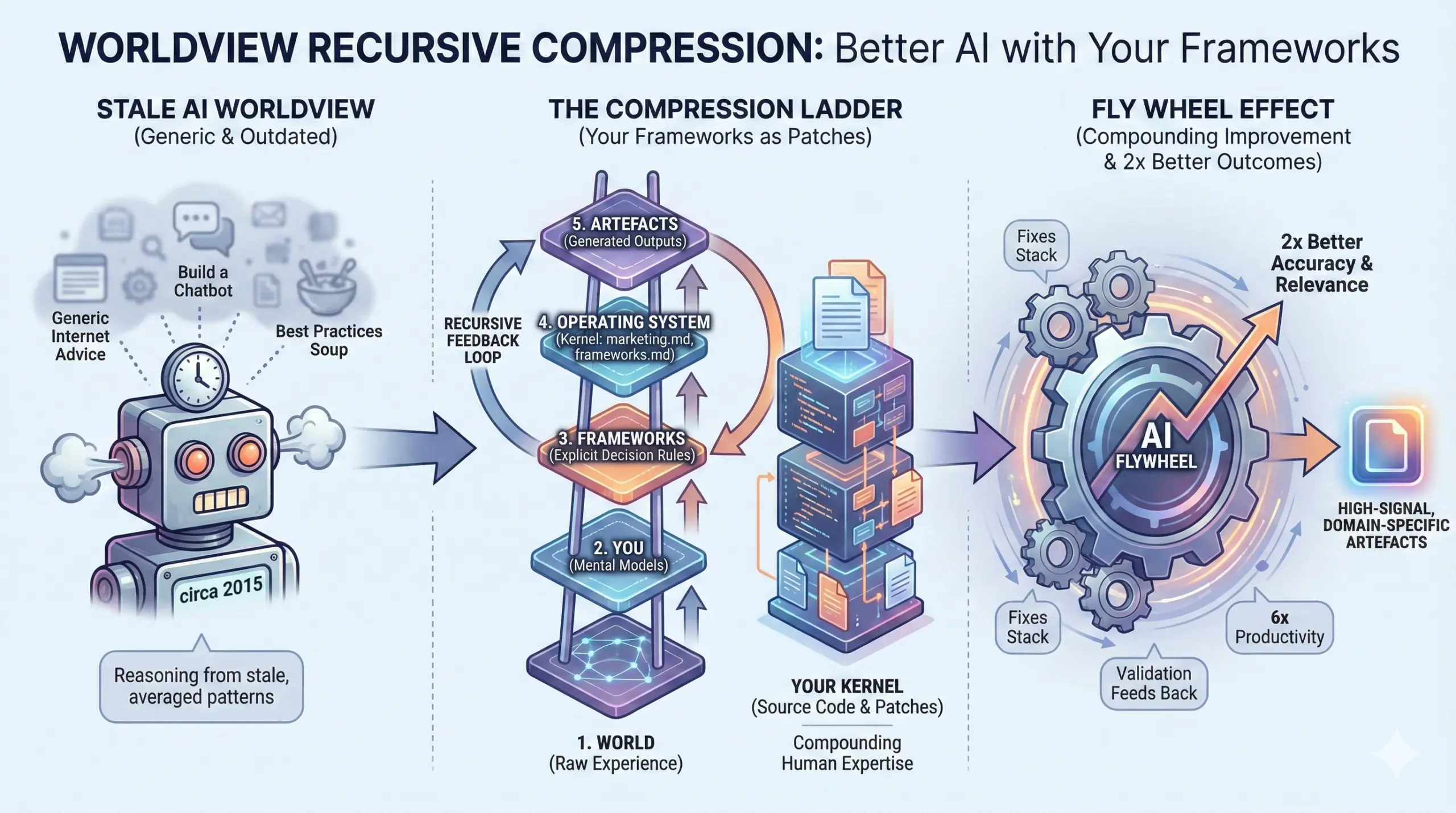
LLMs are frozen in time. Their knowledge cutoff means they’re reasoning from patterns that may already be outdated.
“A knowledge cutoff date represents the point in time beyond which an LLM has no inherent knowledge of events, developments, or information. Unlike humans who continuously learn, LLMs have their knowledge ‘frozen’ at a specific temporal point.”1
But it’s worse than just being outdated. Research shows that even when models can recall recent events, their deep understanding tends to reflect patterns from years earlier:
“The understanding of world events (even in cases where models can remember) lingers around 2015, with a trend towards even earlier years.”2
When you ask an AI for strategic advice, it’s not drawing on cutting-edge thinking. It’s averaging across millions of blog posts, forum discussions, and articles—producing what you might call “generic internet consultant soup.”
Without your frameworks to guide it, the AI defaults to the same recommendations everyone else gets:
Without Frameworks
- “Build a chatbot”
- “Create a dashboard”
- “Automate routine tasks”
- Generic best practices
With Your Frameworks
- “Redesign this process entirely”
- “Augment this specific role”
- “Apply the Autonomy Ladder here”
- Your pattern recognition
The difference isn’t prompting skill. It’s whether the model has access to your worldview—the frameworks you’ve developed through years of practice that the model never encountered in its training data.
Frameworks as Worldview Patches
Your expertise isn’t just knowledge—it’s compressed pattern recognition. When you look at a business problem, you’re not starting from scratch. You’re applying mental models built from hundreds of similar situations.
“You’re not just ‘writing down what you know.’ You’re compressing intuitions into explicit decision rules. Each framework captures 100+ hours of hard-won pattern recognition.”3
These frameworks act as patches for the model’s outdated worldview:
“Your kernel acts as a patch. Your frameworks represent your current thinking—they compress your latest insights into usable form. They ‘patch’ the model’s stale worldview with your frontier knowledge.”4
Think of frameworks as basis vectors for reasoning. Just as any point in 3D space can be expressed as a combination of x, y, and z coordinates, complex domain recommendations can be expressed as combinations of your fundamental frameworks.
Research in AI interpretability supports this view:
“Transformer-based LLMs develop an internal geometry that is both semantically structured and computationally efficient… concepts can be represented as linear combinations of basis vectors in the model’s hidden representation space.”5
When you load your frameworks into context, you’re not just giving the model information—you’re reshaping how it thinks about the problem space.
The Compression Ladder
Worldview compression happens in stages. Most people only operate at the first level or two. The full system creates a recursive loop where each level improves the others.
The Five Levels of Worldview Compression
World — Raw experience, observations, the chaos of reality
→
You — Your mental models, intuitions, pattern recognition
→
Frameworks — Explicit, reusable decision structures
→
Operating System — Your kernel: marketing.md, frameworks.md, constraints.md
→
Artefacts — Generated outputs that embody your worldview
→
The loop closes when artefacts reveal gaps, which improve your frameworks, which refine your thinking, which deepens your understanding of the world.
Most AI users stay at levels 1-2. They have mental models but never externalize them. When they prompt AI, they’re asking a model with an outdated worldview to guess what they would think—and then spending hours correcting the results.
The leverage comes from reaching levels 3-4: explicit frameworks compiled into a persistent “operating system” that loads into every AI interaction.
Two-Pass Compilation
Here’s the architectural insight that changes everything: there are two compilation passes, not one.
Pass 1: Compile Yourself
Before you generate any outputs, you compile your worldview into explicit frameworks:
marketing.md— Who you are, your voice, your positioningframeworks.md— Your thinking tools, decision patternsconstraints.md— What you never recommend, your boundariespatterns.md— Your go-to solution shapes
This is slow, deliberate work. It might take 40-60 hours to do properly. But it only happens once, with incremental updates afterward.
Pass 2: Compile Outputs
With your kernel loaded, every output becomes a “compilation” of your frameworks applied to specific context. The AI isn’t guessing what you’d think—it’s explicitly reasoning through your frameworks.
“Design-time layer: Builder that designs your system. Run-time layer: System that generates outputs. Both layers need your kernel, not just run-time. If only run-time has your kernel, the structure is generic. If design-time has your kernel, the structure itself reflects your thinking.”6
This is why the compiler metaphor matters:
Frameworks as Source Code
“You don’t fix each binary individually (that’s maintenance hell). You fix the source code once (all future binaries are better). Each compilation is cheap (4-8 hours). The source code is the asset (frameworks = IP).”7
When you iterate on outputs, you’re doing maintenance on binaries. When you improve frameworks, you’re improving the source code—and every future output benefits automatically.
The Evidence: 2x Better Outcomes
This isn’t theoretical. Research consistently shows that domain-specific frameworks dramatically outperform generic prompting:
better accuracy and completeness with domain-specific frameworks8
“Domain-specific models consistently outperform generic AI in enterprises by delivering higher accuracy, trust, and relevance.”9
The gains come from how frameworks use the model’s attention:
“Context must be treated as a finite resource with diminishing marginal returns. Like humans, who have limited working memory capacity, LLMs have an ‘attention budget’ that they draw on when parsing large volumes of context.”10
A well-curated 50,000-token context often outperforms a bloated 150,000-token context because frameworks are high-signal, low-noise. They use your attention budget efficiently.
The Flywheel Effect
The real power of worldview compression isn’t just better outputs—it’s compounding improvement.
“Fix 1 framework → Helps 100 future proposals. Fix 5 frameworks → Helps 100 future proposals × 5 = 500 proposal-improvements. Each improvement stacks. By proposal 100, you’re operating with 50-60 kernel improvements.”11
Every output teaches you something. Good outputs validate your frameworks. Bad outputs reveal gaps. But here’s the key: the lesson goes back into frameworks.md, not just into the output.
“Outputs feed back into the kernel. When you generate a good output, it validates your framework. When you generate a bad output, you learn what’s missing. The lesson goes back into frameworks.md, not just into the output. This is worldview recursive compression. Each pass compresses and refines your doctrine.”12
The compounding is dramatic:
- Proposal 1: 10 hours, 40% win rate, 5 frameworks
- Proposal 50: 4 hours, 60% win rate, 50+ kernel improvements
- Proposal 100: 3 hours, 80% win rate, operating at 6x productivity vs competitors
This is the flywheel that data scientists talk about:
“Every time AI interacts with a customer, it’s a chance to learn. Every time a human agent steps in, that’s new training material. Every time you approve an automation, the whole system gets smarter. The flywheel is about creating compounding value.”13
Why Most People Never Build Frameworks
If frameworks are this powerful, why doesn’t everyone have them?
Because most expertise is tacit—embedded in intuition, not written down:
“In management consulting, firms don’t sell products; they sell expertise. Yet research shows that up to 90% of a firm’s expertise is tacit knowledge, embedded in consultants’ heads, shaped by years of lived experience, and rarely written down.”14
Externalizing tacit knowledge is hard work. It requires articulating what you know so well that you don’t even think about it. But this is precisely what creates competitive advantage:
“Anyone can use Claude or GPT. The tools are commoditized. Your frameworks are unique—distilled from YOUR experience, encoding YOUR risk posture and philosophy. The frameworks are the moat. Competitors can’t simply copy them because they don’t have your accumulated pattern recognition.”15
This is the same pattern that built McKinsey and BCG. Their value isn’t individual consultants—it’s codified frameworks developed over decades. The difference is: you can build this asset in weeks, not decades, because AI accelerates the externalization process.
Getting Started: Your First Framework
You don’t need to build an entire operating system to start. Begin with one framework that captures something you know that AI doesn’t:
Framework Template
- Framework Name: [What it diagnoses or decides]
- When to use: [Trigger conditions]
- Inputs required: [What data you need]
- Process: [Steps to apply]
- Outputs: [What decision it yields]
- Failure modes: [When it doesn’t apply]
Start with whatever you find yourself explaining repeatedly. Whatever you wish junior team members understood. Whatever AI keeps getting wrong in ways that frustrate you.
That gap between what you know and what AI produces? That’s your first framework waiting to be written.
The Bottom Line
Your AI outputs feel generic because the model is reasoning from stale, averaged internet patterns. The fix isn’t better prompting—it’s compiling your worldview into frameworks that patch the model’s reasoning with your domain expertise.
The compression ladder—World → You → Frameworks → OS → Artefacts → back—creates a recursive loop where each cycle improves all future outputs. Two-pass compilation (compile yourself first, then compile outputs) means your frameworks become source code, and outputs become regenerable binaries.
The evidence shows 2x improvements from domain-specific frameworks, and the flywheel compounds: by your 100th output, you’re operating at 6x the productivity of someone still iterating on prompts.
The model isn’t the problem. Your inputs are. And you have the expertise to fix them.
What’s one thing you know that AI doesn’t? That’s your first framework.
References
- AllMo.AI. “List of Large Language Model Cut-Off Dates.” allmo.ai/articles/list-of-large-language-model-cut-off-dates — “A knowledge cutoff date represents the point in time beyond which an LLM has no inherent knowledge of events, developments, or information.”
- ArXiv. “Is Your LLM Outdated?” arxiv.org/html/2405.08460v3 — “The understanding of world events (even in cases where models can remember) lingers around 2015, with a trend towards even earlier years.”
- LeverageAI. “The Proposal Compiler.” leverageai.com.au — “You’re not just ‘writing down what you know.’ You’re compressing intuitions into explicit decision rules. Each framework captures 100+ hours of hard-won pattern recognition.”
- LeverageAI. “Stop Nursing Your AI Outputs.” leverageai.com.au — “Your kernel acts as a patch. Your frameworks represent your current thinking—they compress your latest insights into usable form.”
- ArXiv. “Large Language Models Encode Semantics.” arxiv.org/html/2507.09709v1 — “Transformer-based LLMs develop an internal geometry that is both semantically structured and computationally efficient.”
- LeverageAI. “Stop Nursing Your AI Outputs.” leverageai.com.au — “Design-time layer: Builder that designs your system. Run-time layer: System that generates outputs. Both layers need your kernel, not just run-time.”
- LeverageAI. “The Proposal Compiler.” leverageai.com.au — “You don’t fix each binary individually (that’s maintenance hell). You fix the source code once (all future binaries are better).”
- OpenArc. “Domain-Specific AI: Building Custom Agents for Industry Workflows.” openarc.net — “Domain-specific models offer twofold better accuracy and completeness compared to general-purpose models.”
- Innodata. “Domain-Specific AI.” innodata.com — “Domain-specific models consistently outperform generic AI in enterprises by delivering higher accuracy, trust, and relevance.”
- LeverageAI. “Context Engineering.” leverageai.com.au — “Context must be treated as a finite resource with diminishing marginal returns. LLMs have an ‘attention budget’ that they draw on when parsing large volumes of context.”
- LeverageAI. “The Proposal Compiler.” leverageai.com.au — “Fix 1 framework → Helps 100 future proposals. Fix 5 frameworks → 500 proposal-improvements. By proposal 100, you’re operating with 50-60 kernel improvements.”
- LeverageAI. “Stop Nursing Your AI Outputs.” leverageai.com.au — “Outputs feed back into the kernel. This is worldview recursive compression. Each pass compresses and refines your doctrine.”
- Kodif. “The AI Flywheel.” kodif.ai/blog/the-ai-flywheel — “Every time AI interacts with a customer, it’s a chance to learn. The flywheel is about creating compounding value.”
- Starmind. “Unlocking Tacit Knowledge in Consulting Firms.” starmind.ai — “In management consulting, up to 90% of a firm’s expertise is tacit knowledge, embedded in consultants’ heads.”
- LeverageAI. “The Proposal Compiler.” leverageai.com.au — “Anyone can use Claude or GPT. The tools are commoditized. Your frameworks are unique—distilled from YOUR experience. The frameworks are the moat.”
Discover more from Leverage AI for your business
Subscribe to get the latest posts sent to your email.