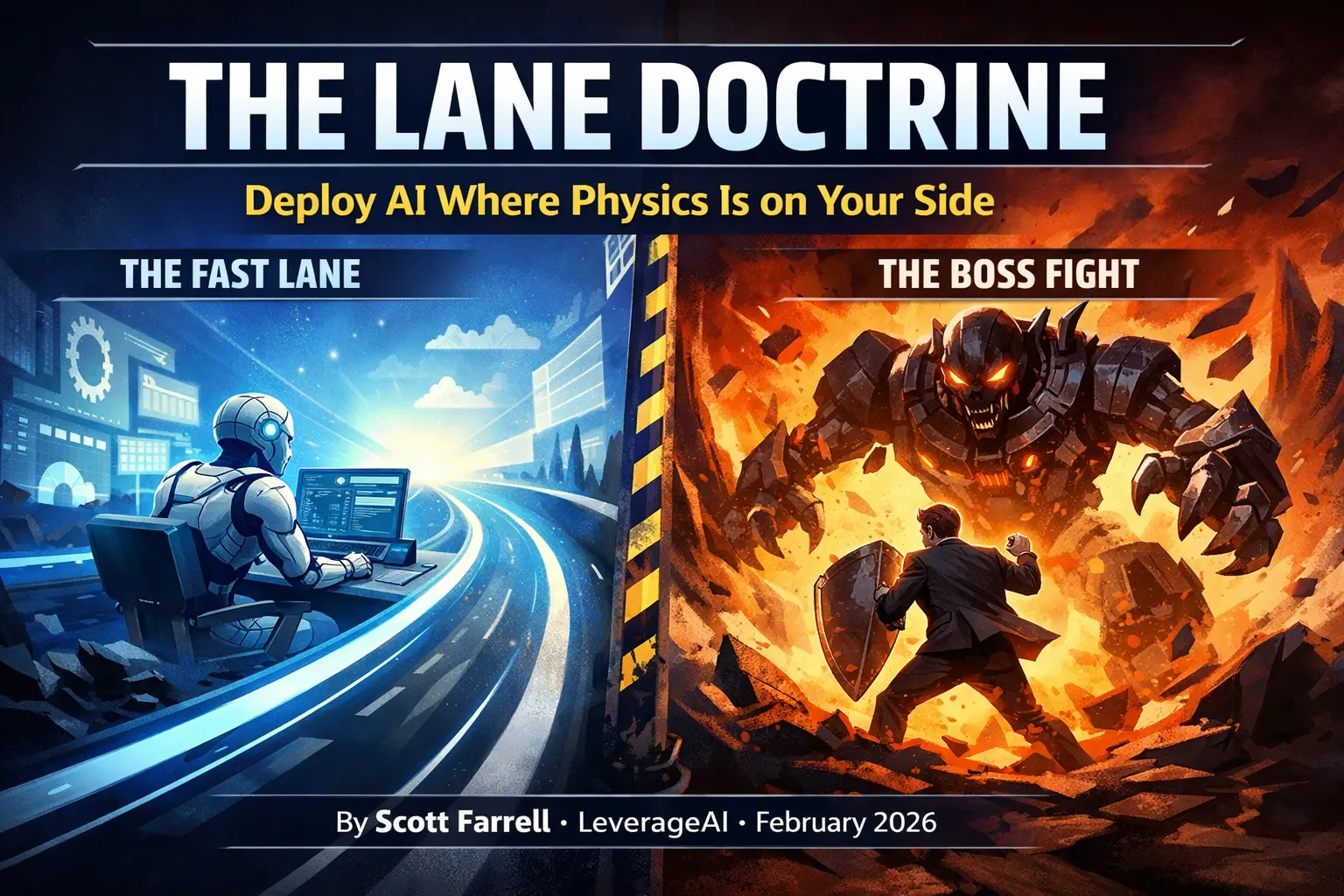
The Lane Doctrine: Deploy AI Where Physics Is on Your Side
Why the ‘safe’ AI project is often the boss fight — and a 7-question test to pick winners instead.
📘 Want the complete guide?
Learn more: Read the full eBook here →
By Scott Farrell · LeverageAI · February 2026
- 70-85% of AI projects fail — not because the technology is bad, but because companies deploy it where structural physics work against it.
- Your instinct from 20 years of IT — “start small, start customer-facing” — is exactly backwards for AI. The “safe” chatbot project is the boss fight.
- The 7-question Lane Test gives you a systematic way to score any AI project and predict success before you spend a dollar.
The Safest Project in Your Portfolio Is Probably the Most Dangerous
Picture the typical AI planning session. The executive team gathers. Someone pitches a chatbot — handle simple customer queries, escalate the hard ones to humans. It’s small. It’s bounded. It feels safe.
Except it isn’t.
That “safe little chatbot” is actually a public-facing stochastic actor operating under sub-second latency constraints, in the exact domain where humans have home-field advantage — social repair, ambiguity handling, emotional nuance, policy interpretation. Of those who interact with chatbots, 78% escalate to a human anyway, and 63% get no resolution at all.1
Meanwhile, the project that actually delivers — internal batch processing, AI-assisted coding, overnight document synthesis — gets dismissed as “too complex” or “too ambitious.”
The instinct is backwards. And 70-85% failure rates prove it.2
Why Your 2015 Risk Model Is Killing Your AI Projects
Traditional IT taught executives a reliable heuristic: start with something simple, customer-facing, and bounded. Prove value. Then expand.
That worked for deterministic software. A CRM either does the thing or throws an error. The risk surface is availability, performance, and security — familiar territory. So “simple customer support automation” really was low-risk.
AI inverts this completely.
A “simple chatbot” is not a small appliance. It’s a probabilistic generator interacting with human psychology in real time. The harm isn’t “it crashes.” The harm is that it confidently says something wrong, offensive, or non-compliant — and you pay for the screenshot forever.
Research in Nature reveals a critical asymmetry: when chatbots fail, customers generalise the failure to all AI interactions, creating a category-level trust death spiral.3 One bad chatbot experience doesn’t just kill that project — it poisons the organisation’s appetite for every AI initiative that follows.
AI projects fail at twice the rate of non-AI IT projects.4 And the root cause, per RAND, isn’t technical capability — it’s “misunderstandings and miscommunications about the intent and purpose” of the project.4 Translation: companies are deploying AI where physics works against it, because their 2015 risk model told them it was safe.
“In classic IT, ‘small + customer-facing’ was safe. In AI, that’s the boss fight.”
AI’s Physics: What It’s Actually Good At
AI has specific, enumerable superpowers. The trick to deploying AI is sticking to the knitting — sticking to what it’s good at, sticking in its own lane.
AI is good at:
- Slow, deep cognition — making decisions, reading documents, cross-checking, being adversarial on itself. It’s good at taking its time.
- Parallelism — running 10 strategy branches simultaneously rather than one-by-one.
- Batch processing — overnight synthesis, queued analysis, nightly decision builds.
- Text and coding — astronomically off the planet at code generation, keeping up with elite programmers.
- Understanding multimedia — reading documents, images, and audio; extracting structure from chaos.
- RAG and semantic search — searching knowledge bases with deep comprehension, not just keyword matching.
- Producing reviewable artefacts — code, tests, documents, proposals, reports that humans can inspect, approve, or reject.
- Always-on, never-fatigued processing — it doesn’t have calendar time constraints, meeting fatigue, or coordination overhead.
What AI is not good at:
- Sub-second response — human conversation turn-taking happens at roughly 200-300 milliseconds.5 That’s a biological constraint, not a technical one. You can’t optimise around it with better models.
- Social repair — handling upset customers, navigating ambiguity, reading emotional subtext.
- Novel governance contexts — operating where no existing compliance framework applies, requiring organisations to invent accountability from scratch.
The meta-rule: if the user can wait, let the model think. If they can’t, redesign the interaction so something else handles the rapid turn-taking while the deep work happens off the clock.
You don’t want to trade intelligence for speed.
The Boss-Fight Rule: Don’t Stack Constraints
Here’s the kill switch for bad AI projects. Every deployment context has three potential constraints:
- Latency constraint — does it need sub-second turn-taking?
- Governance constraint — does it need novel auditability, explainability, or compliance?
- Human-advantage constraint — are humans already excellent here (social repair, ambiguity, tacit judgment)?
If a project triggers two or more of those simultaneously, you’re not “doing AI” — you’re doing heroics. You’re fighting the boss fight.
As soon as you fight more than one problem at once, give up. Real-time voice, for example, faces governance problems and a fast-slow technical problem. Two constraints. Don’t do the project.
A customer-facing chatbot? It triggers all three: sub-second expectations, brand/compliance exposure, and competing with humans at what they do best. That’s the boss fight, not the tutorial level.
Meanwhile, AI-assisted coding triggers none of them: latency is irrelevant (hours or days are fine), governance routes through existing SDLC, and AI is genuinely better than humans at the task. That’s why developers report 55-82% faster task completion.6
The Lane Test: 7 Questions That Predict Success
This is the tool that makes the Lane Doctrine systematic. Score any AI project against these seven questions:
The Lane Test
Score “YES” on at least 3 of questions 3-7 and “NO” on questions 1-2.
- Does it require sub-second answers? (If YES → danger zone)
- Is a mistake public, regulated, or irreversible? (If YES → danger zone)
- Can outputs be reviewed as artefacts? (diffs, tests, checklists) (If YES → good fit)
- Can you run it in batch, overnight, or queue mode? (If YES → good fit)
- Does it benefit from parallelism? (many hypotheses, options, branches) (If YES → good fit)
- Does it create a compounding asset? (frameworks, kernels, reusable playbooks) (If YES → good fit)
- Can you cage it? (least privilege, tokenised data, logged actions) (If YES → good fit)
When you follow that test, you naturally drift toward:
- Code generation with test harnesses
- Nightly decision builds with regression tests and rollback
- RAG-backed analysis and document intelligence
- Proposal systems that show their work
- Overnight batch processing and parallel synthesis
…and away from:
- Real-time customer-facing “one brain does everything” chatbots
- Perfection-driven voice/video mimicry
- Anything that combines latency + governance + human social advantage
Proof: The Numbers Behind the Lane
Coding — The Perfect Lane
AI coding is the single strongest evidence case for the Lane Doctrine. It passes every Lane Test question with flying colours:
| Lane Test Question | Coding Answer |
|---|---|
| Sub-second required? | No. Hours or days are fine. |
| Mistake public/regulated? | No. Nothing hits production without human review. |
| Reviewable artefacts? | Yes. Code, PRs, diffs, test results. |
| Batch/overnight mode? | Yes. Run overnight, review in the morning. |
| Benefits from parallelism? | Yes. Multiple agents coding in parallel. |
| Compounding asset? | Yes. Specs, tests, and frameworks improve over time. |
| Can you cage it? | Yes. Sandboxed environments, CI/CD gates, PR review. |
The results speak for themselves:
- Developers complete tasks 55-82% faster with AI assistance6
- McKinsey reports 56% faster task completion with GitHub Copilot7
- OpenAI built their Agent Builder in six weeks, with AI writing 80% of the PRs8
- Leading developers report 90% of personal code is now AI-generated9
Coding succeeds because it stays in the lane. Outputs are reviewable. Governance routes through existing SDLC — code review, CI/CD, testing. Latency doesn’t matter. Error detection is systematic. It’s governance arbitrage: you’re piping AI value through existing engineering controls instead of inventing new governance theatre.
Batch Processing — 40-60% Cheaper, and Smarter
Batch processing doesn’t just save money. It lets AI be smarter.
When you remove the latency constraint, AI can take its time — run thorough retrieval, cross-check sources, explore multiple approaches, and verify its own work. The economics are dramatic:
A concrete example: a real-time system processing 1 million requests daily might require 100 GPU instances running 24/7, costing approximately $150,000/month. A batch system processes the same volume with 20 GPU instances running 7 hours/day during off-peak pricing — roughly $40,000/month.10 Same output. 73% lower cost. And the batch system produces deeper, more thoroughly reasoned results.
API providers have caught on. Together AI’s Batch API offers a flat 50% discount with 24-hour completion windows.11 The infrastructure economics are explicitly rewarding you for staying in the lane.
Architecture Beats Capability
Perhaps the most striking finding: GPT-3.5 with agentic workflows achieves 95% on HumanEval, while GPT-4 alone scores 48%.12
A weaker model in the right deployment context — one that gives it time, iteration, and tool use — beats a stronger model in a constrained, one-shot context. Architecture matters more than raw capability. The lane matters more than the engine.
The Governance Gap: 85% Plan, 21% Are Ready
Deloitte’s 2026 State of AI report reveals a stark mismatch: 85% of enterprises plan to deploy agentic AI, but only 21% have the governance infrastructure to support it safely.13
Gartner predicts over 40% of agentic AI projects will be cancelled by end of 2027.14
This is exactly the maturity mismatch the Lane Doctrine warns against. Companies attempting high-autonomy deployments with low-maturity governance get one visible mistake — and the project dies. The Lane Test’s first two questions (sub-second latency? public/regulated mistakes?) exist precisely to catch this trap.
The solution isn’t to avoid AI. It’s to deploy AI where your governance muscles are already strong — SDLC, code review, CI/CD, regression testing — and graduate to higher-autonomy deployments only as your containment infrastructure matures.
But What About Customer-Facing AI?
The Lane Doctrine doesn’t say “never do customer-facing AI.” It says don’t start there.
When you must touch real-time, use what we call the Fast-Slow Split: the part that talks doesn’t need to think, and the part that thinks doesn’t need to talk fast. A tiny fast model keeps the conversation flowing while a bigger model does the heavy cognition in parallel.
But here’s the crucial insight: even in customer-facing contexts, the highest-value AI work happens before the interaction. AI prepares the context, researches the account, drafts the response, surfaces the relevant policy — all in batch mode, all in the lane. The human delivers the judgment call in the moment.
That’s not AI replacing the human in real time. That’s AI doing the homework overnight so the human is brilliant by 9am. The lane is bigger than most people think.
The Lane Is Bigger Than You Think
When I say “stay in AI’s lane,” people hear conservatism. They hear “don’t be ambitious.”
It’s the opposite. The lane is massive:
- Coding entire systems overnight
- Batch analysis of every transaction, not just a sample
- Nightly decision builds with regression tests and rollback
- Document intelligence across thousands of pages
- Parallel strategic exploration — test 50 approaches in simulation
- Adversarial self-checking (AI challenging its own conclusions)
- RAG-backed knowledge search across your entire corpus
- Legacy system replacement via observed behaviour converted to specs15
The only thing outside the lane is real-time, customer-facing, high-stakes interactions where humans already excel. That’s one narrow category. Everything else is fair game.
And what’s inside the lane isn’t just “safe.” It’s where Version 3 value lives — work that was structurally impossible before cheap parallel cognition existed. Things like:
- Hyper-sprints: what takes 50 people six months, done overnight
- Marketplace of one: per-customer offers, risk rules, service levels
- Exhaustive scenario exploration that humans couldn’t attempt due to coordination overhead
That’s not a 15% efficiency bump. That’s a different category of capability.
The Punchline
“Keep AI in its lane” isn’t conservative — it’s how you get the compounding curve without getting murdered by the constraint stack.
You’re not avoiding hard problems. You’re avoiding badly-posed problems.
And that’s what being in the fast lane actually looks like: not faster typing — better problem geometry.
Batch the brain. Ship the artefacts. Govern like software.
Score your current AI project against the Lane Test.
If it fails questions 1-2 and doesn’t pass questions 3-7, you just saved yourself six months of frustration and $50K-$300K of wasted spend.
If it passes — you’ve found your fast lane.
References
- [1]Forbes / UJET. “Chatbot Frustration Survey.” — “72% consider chatbots a complete waste of time; 78% escalate to human; 63% get no resolution.” forbes.com/sites/chriswestfall/2022/12/07/chatbots-and-automations-increase-customer-service-frustrations-for-consumers-at-the-holidays/
- [2]NTT Data. “GenAI Deployment Failure Analysis.” — “Between 70-85% of GenAI deployment efforts are failing to meet their desired ROI.” nttdata.com/global/en/insights/focus/2024/between-70-85p-of-genai-deployment-efforts-are-failing
- [3]Nature. “Consumer Trust in AI Chatbots — Service Failure Attribution.” — “Human-like chatbot features raise customer expectations; failure creates category-level trust death spiral.” nature.com/articles/s41599-024-03879-5
- [4]RAND Corporation. “Root Causes of Failure for Artificial Intelligence Projects.” — “AI projects fail at 2× the rate of non-AI IT projects; misunderstandings about intent and purpose are the most common reason.” rand.org/pubs/research_reports/RRA2680-1.html
- [5]PNAS. “Universals and cultural variation in turn-taking in conversation.” — “Human turn-taking gaps are typically ~200-300 milliseconds — a cross-cultural biological universal.” pnas.org/doi/10.1073/pnas.0903616106
- [6]GitHub Copilot Study. “The Impact of AI on Developer Productivity.” — “Developers complete tasks 55-82% faster with AI assistance.” arxiv.org/abs/2302.06590
- [7]McKinsey. “Capturing AI Potential in TMT.” — “Software developers using GitHub Copilot completed tasks 56% faster.” mckinsey.com (PDF)
- [8]LinkedIn / OpenAI Internal Usage. — “OpenAI Agent Builder developed in under six weeks, with Codex writing 80% of the PRs.” linkedin.com/posts/justinhaywardjohnson_openai-unveils-o3-and-o4-mini-activity-7318687442868342784-1l3m
- [9]Theo Browne. “You’re falling behind. It’s time to catch up.” — “90% of personal code now AI-generated among leading developers.” youtube.com/watch?v=Z9UxjmNF7b0
- [10]Zen van Riel. “Real-Time vs Batch Processing Architecture.” — “40-60% cost reduction for batch AI vs real-time; $150K/month (100 GPUs 24/7) vs $40K/month (20 GPUs, 7hrs/day).” zenvanriel.nl/ai-engineer-blog/should-i-use-real-time-or-batch-processing-for-ai-complete-guide/
- [11]Together AI. “Introducing the Batch API.” — “50% cost discount with 24-hour completion window.” together.ai/blog/batch-api
- [12]Andrew Ng via Insight Partners. “Why Agentic AI is the Smart Bet.” — “GPT-3.5 with agentic workflows achieves 95% on HumanEval vs GPT-4 alone at 48%.” insightpartners.com/ideas/andrew-ng-why-agentic-ai-is-the-smart-bet-for-most-enterprises/
- [13]Deloitte. “State of AI in the Enterprise 2026.” — “85% plan agentic AI deployment; only 21% have governance infrastructure.” deloitte.com/us/en/about/press-room/state-of-ai-report-2026.html
- [14]Gartner. “Agentic AI Project Cancellation Prediction.” — “Over 40% of agentic AI projects will be cancelled by end of 2027.” gartner.com/en/newsroom/press-releases/2025-06-25-gartner-predicts-over-40-percent-of-agentic-ai-projects-will-be-canceled-by-end-of-2027
- [15]LeverageAI. “Maximising AI Cognition and AI Value Creation.” — “What takes 50 people six months can happen overnight. AI doesn’t have calendar time constraints.” leverageai.com.au/maximising-ai-cognition-and-ai-value-creation/
leverageai.com.au · LinkedIn
Discover more from Leverage AI for your business
Subscribe to get the latest posts sent to your email.