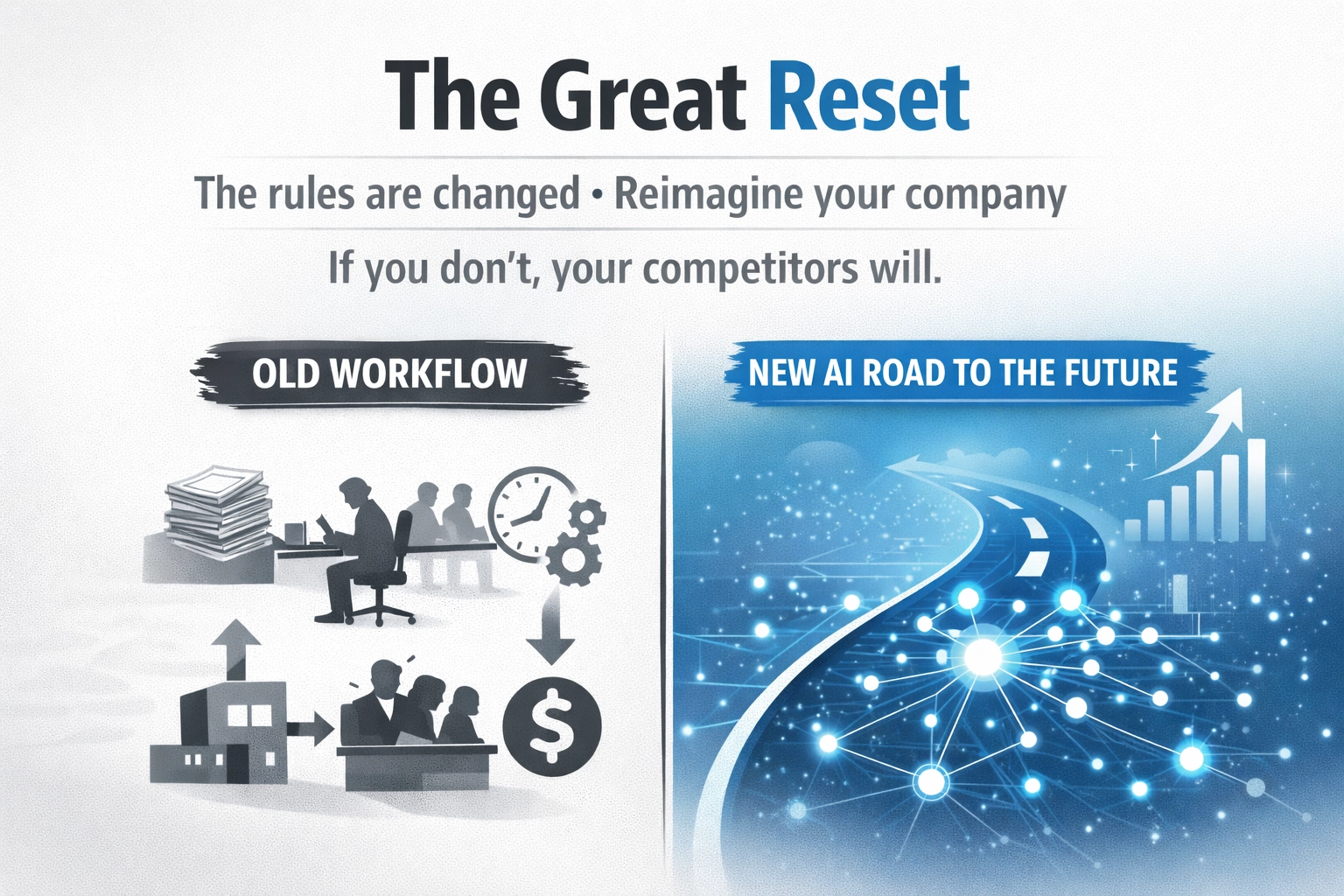
The Great Reset: AI Has Changed the Rules of Business — Reimagine Your Company
Why 95% of AI pilots fail and what high performers do instead
📘 Want the complete guide?
Learn more: Read the full eBook here →
The Question That Betrays You
The question your executive team is asking reveals everything.
“What can we automate with AI? What processes can we save 15-20% on?”
It sounds pragmatic. It feels like responsible leadership. It’s exactly what your board expects to hear. And it’s the question that will cost you the company.
Because here’s what the data actually shows: 95% of AI pilots deliver zero ROI despite $30-40 billion in enterprise investment.1 Across the industry, 70-85% of GenAI deployments are failing to meet their ROI targets.2 Only 4% of organizations generate substantial value from AI, despite 78% having adopted it in at least one business function.3
The conventional wisdom says this is an execution problem. Deploy better, measure tighter, scale smarter. But look closer at who’s winning.
High performers aren’t asking “what can we automate?” They’re 2.8 times more likely to fundamentally redesign workflows rather than optimize them.4 The gap isn’t subtle: 55% of high performers are redesigning workflows from scratch, compared to just 20% of everyone else. And that gap is compounding every quarter.
The data isn’t telling you to execute better. It’s telling you the strategy itself is wrong.
When you ask “what can we automate?” you’re revealing process-optimization thinking. You’re assuming your current processes are fundamentally correct and just need efficiency gains. You’re treating AI as a faster hammer when the entire construction industry just changed.
It’s “what becomes newly possible when thinking is abundant and parallel?”
When the Unit of Production Changes
There’s a pattern in economic history. When a fundamental input cost drops dramatically, the entire value chain built on scarcity of that input becomes obsolete.
In the 1990s, computation became cheap. Companies that optimized their paper-based processes lost to companies that rebuilt everything around abundant computation. It wasn’t about doing the same work faster—it was about discovering what becomes possible when processing power is no longer the constraint.
We’re in that moment again, but the input that’s dropping isn’t computation. It’s cognition itself.
LLM inference costs are falling 10x per year.5 GPT-4 equivalent performance that cost $20 per million tokens in late 2022 now costs $0.40—a 1,000x reduction in three years.6 The rate of decline is faster than compute costs during the PC revolution and faster than bandwidth costs during the dot-com boom.
What does it mean when thinking becomes cheap?
Your existing processes were designed in a world where cognition was expensive. Every workflow assumes human thinking is scarce, sequential, and costly. So you standardized. You created average solutions for average customers. You optimized for scale because customization didn’t scale.
Those assumptions are now false.
When cognition is cheap and parallel, you don’t need to standardize. You can customize for every customer. You don’t need to average across cases. You can think deeply about each specific situation. The economics flip from economies of scale (standardize, average, reproduce) to economies of specificity (customize per customer at scale).
This is what I call the Marketplace of One. Every customer gets a bespoke solution, not because you’re inefficient, but because thinking is no longer the constraint. The competitive advantage shifts from “we’ve standardized well” to “we customize perfectly.”
But here’s the trap: if you’re asking “what can we automate?” you’re optimizing for the old economics. You’re making the scarcity assumption more efficient. Which means you’re setting concrete faster on an obsolete foundation.
Every automation of an existing process does four things simultaneously:
- Validates the process design — signals that the current workflow is correct
- Adds switching costs — makes it harder to reimagine later
- Defers fundamental questioning — delays the “should this exist?” conversation
- Sets concrete faster — locks you into old patterns while competitors rebuild
McKinsey’s data confirms this. High performers are fundamentally redesigning workflows—not optimizing them—at 2.8x the rate of everyone else.4 When organizations pair generative AI with end-to-end transformation, productivity gains routinely hit 25-30%, compared to 10-15% from tools alone.7
The question shifts. Not “what can we automate?” but “if we built this from scratch today, with abundant cognition as a given, what would we create?”
The Vendor Trap
I had a client tell me recently: “We just want to buy existing applications that have AI built in. We don’t need an AI consultant.”
It’s the most seductive trap in business right now.
Buy an app with AI features. Salesforce with the AI agent in the middle of your screen. Vendor co-pilots selling you a little bit of AI to generate revenue off your budget. It looks pragmatic. It feels low-risk. Your board will love it because it shows you’re “doing something about AI.”
Here’s what’s actually happening: you’re buying their automation of their generic workflow assumptions. You’re locking yourself into old patterns with slightly better performance.
Think about what a vendor co-pilot actually is. It’s software designed to make you better at using their software, which was designed for the average customer in your category. The entire value proposition is “use our tool more efficiently.”
But if the tool itself assumes standardization economics, then AI-powered efficiency just means you’re standardizing faster. You’re getting a 10% bump on a process that shouldn’t exist in the cognition-abundant world.
Let me give you a concrete example of what this looks like when it goes wrong.
AI-written rejection emails. Companies are using AI to write better “we can’t help you” messages. The result? Fifteen paragraphs of polite, perfectly-formatted AI tone to say “no.” It takes longer to read than the old two-sentence rejection. It sounds like every other AI-generated email. It’s destroying your brand, not helping it.
This is the difference between buying a gadget and building a factory.
A vendor co-pilot is a better spanner. Building your own cognition layer is automotive manufacturing capability. The spanner helps you turn bolts faster. The factory lets you manufacture entirely new things.
Now, to be clear: I’m not saying don’t buy infrastructure. Buy LLM APIs. Buy hosting. Buy the commodity components. What you can’t buy is strategy. You can’t outsource “what should our value proposition be when cognition is cheap?”
Vendors will sell you their answer to that question. And their answer is: “Keep doing what you’re doing, but 15% faster with our tool.”
The data backs this up. Only 25% of AI initiatives deliver expected ROI.8 Enterprise AI initiatives are achieving just 5.9% ROI against a 10% capital investment threshold.9 And here’s the kicker: more than 80% of organizations face vendor lock-in issues, with switching costs typically twice the initial investment.10
The contracts you’re signing in 2026 will constrain your strategic options for 3-5 years. If you sign before reimagining your value proposition, you’ve chosen the old path. And the concrete is already setting.
What Reimagination Actually Looks Like
Let’s get concrete. What does “reimagine your company around cheap cognition” actually mean?
Not burning down your existing business. Not ignoring what works. Not replacing your entire workforce.
It means discovering the adjacent possible—what becomes newly viable when thinking is abundant, parallel, and always-on.
Here’s a real example from McKinsey’s research. A major bank transformed their credit memo creation process. The old workflow: 40 employees, 10 handoffs, 60-100 days to complete. The reimagined workflow using agentic AI: 4-5 employees, zero handoffs, one day to complete.11
That’s not 15% efficiency. That’s not automation of existing steps. That’s zero-based redesign asking: “If we could build this from scratch with AI, what’s the simplest path to the outcome we need?”
Or take this pharmaceutical company example. They reimagined a compliance workflow with agentic AI and saw processes run five times faster at half the previous cost.12 Another organization automated 80% of a workflow once considered too unstructured for automation.13
Notice the pattern? These aren’t marginal improvements. They’re order-of-magnitude transformations achieved by questioning the fundamental design.
The shift in thinking looks like this:
Optimization thinking says: “Our sales process has twelve steps. Let’s automate step 4 and step 9 to save 15% of time.”
Reimagination thinking says: “Why do these twelve steps exist? What if AI could do exhaustive preparation on every prospect, and the human only steps in for judgment calls and relationship moments?”
Optimization thinking says: “Let’s use AI to write better rejection emails.”
Reimagination thinking says: “Why are we rejecting customers? What would it take to serve them if thinking wasn’t the constraint?”
Optimization thinking says: “Let’s deploy a chatbot to handle routine customer inquiries.”
Reimagination thinking says: “What if AI could maintain context across every customer interaction and surface insights no human could see across thousands of cases?”
This is the Marketplace of One in action. When thinking is cheap and parallel, you can direct cognition at unique problems instead of averaging across them. You can treat every customer case as a first-class problem deserving deep analysis. You can customize solutions that were economically impossible before.
The competitive moat shifts from “we’ve standardized efficiently” to “we customize perfectly.” From “we have best practices” to “we have best practice for you specifically.”
And this isn’t theoretical. The high performers in McKinsey’s research are already doing it. They’re 2.8x more likely to fundamentally redesign workflows.4 They spend more than 20% of their digital budgets on AI.14 They’re 3x more likely to have senior leaders actively championing transformation.15
And here’s the economic prize: organizations that redesign work around AI could unlock $2.9 trillion in annual value in the United States alone by 2030—but only if they redesign rather than just automate tasks in isolation.16
The Five-Month Roadmap
So how do you actually do this? How do you move from “what can we automate?” thinking to company reimagination?
The answer isn’t a five-year transformation program. It’s a five-month discovery timeline to achieve strategic clarity about where you’re going. Then the transformation follows from that clarity.
Here’s what those five months look like.
Month 1: Map the Value Frontier
This isn’t about identifying processes to optimize. It’s about asking: What becomes newly possible when thinking is abundant?
Your executive team needs to spend Month 1 in discovery mode. Not running pilots. Not signing vendor contracts. Asking uncomfortable questions about your value proposition.
Activities:
- Run executive sessions exploring: “If we launched today with AI as core infrastructure, what would we build?”
- Build a customer problem inventory—not problems you currently solve, but problems you couldn’t solve when thinking was expensive
- Research what competitors are doing (most won’t be reimagining yet, but some are)
- Map your “value frontier”—the gap between what you deliver today and what becomes viable with cheap cognition
Deliverable: A value frontier map showing current state vs possible state. Not a business case. Not a pilot plan. A strategic hypothesis about where cognition abundance changes your competitive position.
Month 2: Build Your Cognition Layer
Now you learn the medium. You’re not building production systems yet. You’re building enough AI capability to understand what’s actually possible.
Pick one workflow—preferably internal, not customer-facing. Build a thin AI layer over it using commodity APIs (GPT-4, Claude, whatever). The goal isn’t to deploy. It’s to learn.
Activities:
- Build a basic agentic system for one internal workflow
- Use it internally to understand capabilities and limitations
- Learn what “70-90% AI-generated code” actually means in practice
- Document what changes when cognition is abundant in this workflow
Deliverable: A working prototype and team learning about AI capabilities. You’re not proving ROI yet. You’re building organizational muscle memory.
Here’s the economic reality that makes this viable: developers using AI now complete tasks 55.8% faster (2 hours 41 minutes drops to 1 hour 11 minutes).17 Production teams report 70-90% of code is now AI-generated.18 This isn’t future tech—it’s operational reality today.
Month 3: Deploy Silent AI
Month 3 is where you deploy for real, but silently. No customer-facing changes. No brand risk. No governance nightmare.
Put AI to work in non-customer-facing contexts. Measure what changes. Learn what works. Build confidence in the medium without betting the brand.
Activities:
- Deploy AI in internal processes where mistakes are cheap
- Measure cycle time, quality, insights generated
- Track what decisions change when you have exhaustive analysis available
- Document the delta between old workflow and AI-enabled workflow
Deliverable: Metrics showing what abundant cognition actually changes in your operations. Not ROI yet, but signal. What decisions are better? What’s faster? What new patterns emerge?
Month 4: Graduate to AI Factory Thinking
Now the strategic pivot happens. You shift from “automate tasks” to “manufacture cognitive solutions.”
This is when you ask: What do we actually make now? If AI is our factory, what are we manufacturing?
Activities:
- Run strategic sessions reframing your business: “We manufacture ______ using AI as core production capability”
- Sketch the reimagined value proposition based on what you learned in Months 1-3
- Map the operating model changes required (not how to optimize current model, but what model fits the new value prop)
- Identify what capabilities you need to build vs buy
Deliverable: A reimagined value proposition statement and operating model sketch. This is your strategic clarity. This is what the five months are for.
Month 5: Test Autonomous Cognition
The final month is where you test the edge. What can actually run without human loop?
Not everything should be autonomous. But some things can be. Month 5 is about identifying which is which.
Activities:
- Identify workflows that could run autonomously (repetitive, governed by clear rules, low-stakes)
- Build prototypes of autonomous systems
- Test with human oversight but minimal intervention
- Measure what breaks and what works
Deliverable: A decision point. After five months, you know: What’s your reimagined value proposition? What capabilities do you need? What should be autonomous vs human-led? Where do you build vs buy?
This is the clarity that matters. Not a five-year transformation roadmap. Not a vendor shortlist. Strategic understanding of what your company becomes when cognition is cheap.
And here’s the evidence it’s achievable: Bain reports that companies can have an achievable plan in place within six months, with as much as half the expected value realized within the first year.19 Leading companies are on course to achieve 25%+ cost savings by combining end-to-end process redesign with AI deployment.20
Why Five Months, Not Five Years
This is the question every board asks: “Why the urgency? Can’t we take our time and get this right?”
Here’s why five months.
First: The 2026 audit moment. McKinsey flags this year as when boards demand AI spending shows value.21 Forrester projects enterprises will defer 25% of planned AI spend into 2027 due to ROI concerns.22 Gartner says over 40% of agentic AI projects will be canceled by end of 2027 due to unclear business value.23
Companies still in “pilot purgatory” will face budget cuts. The window to pivot from experimentation to strategic clarity is closing.
Second: Competitive timing. You can’t see your competitors’ strategic bets until they launch. The high performers who are fundamentally redesigning workflows right now? Their moves are invisible to you until deployment. By then, it’s too late to catch up.
The 2.8x gap between redesigners and optimizers is already visible in the data.4 That gap compounds quarterly. Every month you spend on vendor evaluations instead of value reimagination widens it.
Third: Vendor lock-in decisions. The contracts you’re signing in 2026 lock strategic options for 3-5 years. 80% of organizations face vendor lock-in, with switching costs at 2x initial investment.10
If you sign a big vendor contract before spending five months discovering your reimagined value proposition, you’ve chosen the optimization path. And the switching costs make it very expensive to pivot later.
Fourth: Capability acceleration. What was cutting-edge AI six months ago is commodity now. LLM costs are falling 10x per year.5 The “we need to wait for AI to mature” argument is backwards. It’s mature enough today to reimagine around. And it will be cheaper and more capable next month.
The strategic window isn’t about technology maturity. It’s about making your bet before competitors make theirs and before vendor contracts lock you into old patterns.
Fifth: Customer expectations are shifting. Your customers are starting to experience AI-enabled service in other parts of their lives. Their baseline for “good enough” is rising. They’re shifting from valuing “faster and cheaper” to valuing “previously impossible.”
When your competitor launches a Marketplace of One offering—truly customized solutions at scale—your standardized offering starts looking obsolete. Even if it’s 15% more efficient than it used to be.
Five months isn’t about rushing. It’s about achieving strategic clarity before the window closes. The discovery can happen fast because you’re not deploying a full transformation in five months. You’re deciding what transformation to pursue.
Then the transformation follows from clarity. And you have a strategic direction while competitors are still running pilots.
The Stakes
Let me paint two scenarios for you.
Path A: Optimization
You ask “what can we automate?” You run vendor evaluations. You sign contracts with Salesforce, Microsoft, whoever promises AI-powered versions of tools you already use. You deploy co-pilots. You celebrate 15% efficiency gains. Your board is satisfied that you’re “doing AI.”
Two years from now, you discover a competitor has rebuilt their entire value proposition around cheap cognition. They’re delivering Marketplace of One solutions—truly customized, genuinely better—at your standardized price point. Your 15% efficiency gains don’t matter because you’re competing on the wrong axis.
You want to pivot. But you’re locked into 3-5 year vendor contracts. Switching costs are 2x your initial investment. Your team learned to use vendor tools, not to build AI capability. You’re three years behind, with expensive concrete set around an obsolete architecture.
Path B: Reimagination
You spend five months asking “what becomes newly possible?” You delay vendor commitments. You build thin cognition layers to learn the medium. You achieve strategic clarity about your reimagined value proposition. You know what to build, what to buy, where to deploy autonomous cognition.
You start building. Not everything at once, but with direction. Your first AI factory takes investment and time. Your second is faster. Your third reuses infrastructure and deploys in weeks.
Two years from now, you’re delivering value that was impossible before. Your competitive moat is “we customize perfectly” not “we’ve standardized efficiently.” You built capability, not dependency. When the next AI breakthrough happens, you can integrate it because you own your cognition layer.
The high performer gap compounds. The organizations redesigning workflows are 2.8x more likely to be doing the right work.4 They’re achieving 25-30% productivity gains vs 10-15% for tool deployments.7 They’re unlocking order-of-magnitude improvements: 5x speed, 50% cost, 60-100 days compressed to one day.1112
This isn’t a race between fast and slow. It’s a race between optimization of existing models and reimagination of value propositions. The data is unambiguous: optimization fails at 70-95% rates.12 Redesign wins with 25%+ improvements.20
The question is: which path do you want to be on in two years?
Start Monday
Here’s what you do Monday morning:
1. Block your executive team’s calendar for Month 1 discovery.
Not an afternoon brainstorm. Four weeks of structured exploration asking: “What becomes newly possible when thinking is abundant?” You need executive time, not delegated strategy work. The high performers have 3x more senior leadership actively championing AI transformation.15 This isn’t a CTO project. It’s a company strategy question.
2. Pause vendor contract negotiations.
Not forever. For five months. Tell your procurement team: “We’re conducting value discovery before committing to architecture.” Any vendor worth working with will understand. The ones who pressure you to sign before you’ve discovered your reimagined value proposition? Those are the ones to avoid.
3. Redirect one pilot budget to the five-month roadmap.
You probably have pilot budget sitting somewhere. Money allocated for “AI experimentation” that’s delivering 10-15% gains on processes that shouldn’t exist. Redirect it. Use it for Month 2’s cognition layer build and Month 3’s silent AI deployment. You’re not asking for new budget. You’re redeploying existing spend toward strategic clarity instead of tactical efficiency.
4. Bring this article to your board.
Frame it as: “We need to discuss whether our AI strategy is optimization or reimagination. The data shows a 2.8x gap between companies redesigning workflows vs optimizing them. Which path are we on?”
Your board has been hearing “AI transformation” rhetoric for two years. They’re getting skeptical because 95% of pilots fail. Give them a different frame: “We’re spending five months discovering our reimagined value proposition before we deploy. Strategic clarity first, then transformation.”
That’s the conversation that matters. Not “should we do AI?” but “are we optimizing or reimagining?”
Because the reset isn’t coming. The reset happened. Cognition is cheap now. Token costs fell 1,000x in three years.6 The economics that shaped your current business model no longer apply. The question isn’t whether to adapt. It’s whether you’ll optimize the old model or reimagine around the new abundance.
Companies that optimize existing workflows will lose to companies that rebuilt around cheap cognition. Not because optimization is bad execution. Because it’s the right execution of the wrong strategy.
The reset starts with a question.
Not “what can we automate?”
But “what becomes newly possible when thinking is abundant?”
Five months from now, you’ll have your answer. And strategic clarity your competitors lack.
Start Monday.
References
- [1]MIT State of AI in Business 2025 Report. “95% of AI pilots show zero ROI despite $30-40B in enterprise investment.” Available at: https://mlq.ai/media/quarterly_decks/v0.1_State_of_AI_in_Business_2025_Report.pdf
- [2]RAND Corporation via Fullview AI Statistics 2025. “70-85% of AI projects still fail, and over 80% of AI projects fail—twice the failure rate of traditional IT projects.” Available at: https://www.fullview.io/blog/ai-statistics
- [3]BCG: The Widening AI Value Gap (October 2025). “Only 4% generate substantial value despite 78% of organizations using AI in at least one business function.” Available at: https://media-publications.bcg.com/The-Widening-AI-Value-Gap-October-2025.pdf
- [4]McKinsey: The State of AI in 2025. “High performers are nearly three times as likely as others to say their organizations have fundamentally redesigned individual workflows.” Available at: https://www.mckinsey.com/capabilities/quantumblack/our-insights/the-state-of-ai
- [5]Andreessen Horowitz: LLMflation. “LLM inference cost is decreasing by 10x every year, which is faster than compute cost during the PC revolution or bandwidth during the dotcom boom.” Available at: https://a16z.com/llmflation-llm-inference-cost/
- [6]Epoch AI: LLM Inference Price Trends. “The cost of LLM inference has dropped by a factor of 1,000 in 3 years. More specifically, GPT-4 equivalent performance now costs $0.40/million tokens versus $20 in late 2022.” Available at: https://epoch.ai/data-insights/llm-inference-price-trends
- [7]Bain: Unsticking Your AI Transformation. “When organizations pair generative AI with end-to-end transformation, productivity gains don’t just look bigger—they are bigger, routinely in the twenty-five to thirty percent range.” Available at: https://www.bain.com/insights/unsticking-your-ai-transformation/
- [8]IBM CEO Study via research compilation. “Only 25% of AI initiatives delivered expected ROI.” Context: Enterprise AI adoption patterns 2024-2025.
- [9]IBM 2023 Enterprise AI Study. “Enterprise-wide AI initiatives achieve just 5.9% ROI vs 10% capital investment threshold.” Context: ROI gap analysis across enterprise deployments.
- [10]Contus: Build vs Buy AI Solution in 2026. “More than 80% of cloud-migrated organizations face vendor lock-in issues, limiting flexibility and creating dependency on a single provider’s technology roadmap. Switching between AI technologies from different vendors proves costly and labor-intensive – typically twice as expensive as your initial investment.” Available at: https://www.contus.com/blog/build-vs-buy-ai/
- [11]McKinsey: Seizing the Agentic AI Advantage. “A major bank transformed their credit memo creation process from 40 employees and 10 handoffs taking 60-100 days to 4-5 employees with 0 handoffs taking 1 day.” Available at: https://www.mckinsey.com/capabilities/quantumblack/our-insights/seizing-the-agentic-ai-advantage
- [12]Capgemini: Real-World Payoff of Agentic AI. “One pharmaceutical enterprise adopted agentic AI in a reimagined compliance workflow and saw processes run five times faster and at half the previous cost.” Available at: https://www.capgemini.com/us-en/insights/expert-perspectives/the-real-world-payoff-of-agentic-ai-and-zero-based-redesign/
- [13]Capgemini: Real-World Payoff of Agentic AI. “One client’s agentic process redesign shattered expectations – automating 80 percent of a workflow once considered too unstructured for automation.” Available at: https://www.capgemini.com/us-en/insights/expert-perspectives/the-real-world-payoff-of-agentic-ai-and-zero-based-redesign/
- [14]Digital Strategy AI: State of AI 2025 McKinsey Report. “More than one-third of AI high performers spend more than 20% of their digital budgets on AI.” Available at: https://digitalstrategy-ai.com/2025/11/23/ai-mckinsey-report-2025/
- [15]VantagePoint: State of AI in Financial Services 2025. “High-performing organizations are 3× more likely to have senior leaders who actively champion AI.” Available at: https://vantagepoint.io/blog/sf/the-state-of-ai-in-financial-services-key-insights-for-2025-and-what-they-mean-for-your-firm
- [16]McKinsey: A New Year’s Resolution for Leaders. “Organizations redesigning work around partnerships between people, AI agents, and robots could unlock about $2.9 trillion in annual economic value in the United States alone by 2030—but only if organizations redesign work rather than automating tasks in isolation.” Available at: https://www.mckinsey.com/mgi/media-center/a-new-years-resolution-for-leaders-redesign-work-for-people-and-ai
- [17]GitHub Copilot Study. “Developers completed tasks 55.8% faster with GitHub Copilot. Average completion time dropped from 2 hours 41 minutes to 1 hour 11 minutes.” Context: Productivity research on AI-assisted development.
- [18]Theo Browne (t3.gg) developer productivity reports. “90% of Theo’s personal code is now AI-generated; 70%+ AI-generated code in his production teams.” Context: Real-world production development patterns.
- [19]Bain: Zero-Based Redesign. “An achievable plan can be in place within six months in many cases, with as much as half the expected value realized within the first year.” Available at: https://www.bain.com/insights/zero-based-redesign-the-key-to-realizing-gen-ai-cost-savings-potential/
- [20]Bain: Zero-Based Redesign. “Leading companies are on course to achieve cost savings of up to 25% by combining end-to-end process redesign with generative AI tool deployment.” Available at: https://www.bain.com/insights/zero-based-redesign-the-key-to-realizing-gen-ai-cost-savings-potential/
- [21]McKinsey State of AI 2025 and 2026 industry analysis. “McKinsey flags 2026 as the year when boards demand AI spending shows value, creating an ‘audit moment’ for enterprise AI initiatives.” Context: Industry analyst predictions for AI ROI accountability.
- [22]Gartner AI Spending Forecast 2026. “Forrester’s 2026 predictions declare ‘the AI hype period ends,’ projecting enterprises will defer 25% of planned AI spend into 2027 due to ROI concerns.” Available at: https://www.christianandtimbers.com/insights/why-does-gartner-describe-2026-as-a-trough-of-disillusionment-year-for-ai
- [23]Jones Walker: Ten AI Predictions for 2026. “Gartner adds that over 40% of agentic AI projects will be canceled by end of 2027 due to escalating costs or unclear business value.” Available at: https://www.joneswalker.com/en/insights/blogs/ai-law-blog/ten-ai-predictions-for-2026-what-leading-analysts-say-legal-teams-should-expect.html?id=102lz7f
Discover more from Leverage AI for your business
Subscribe to get the latest posts sent to your email.