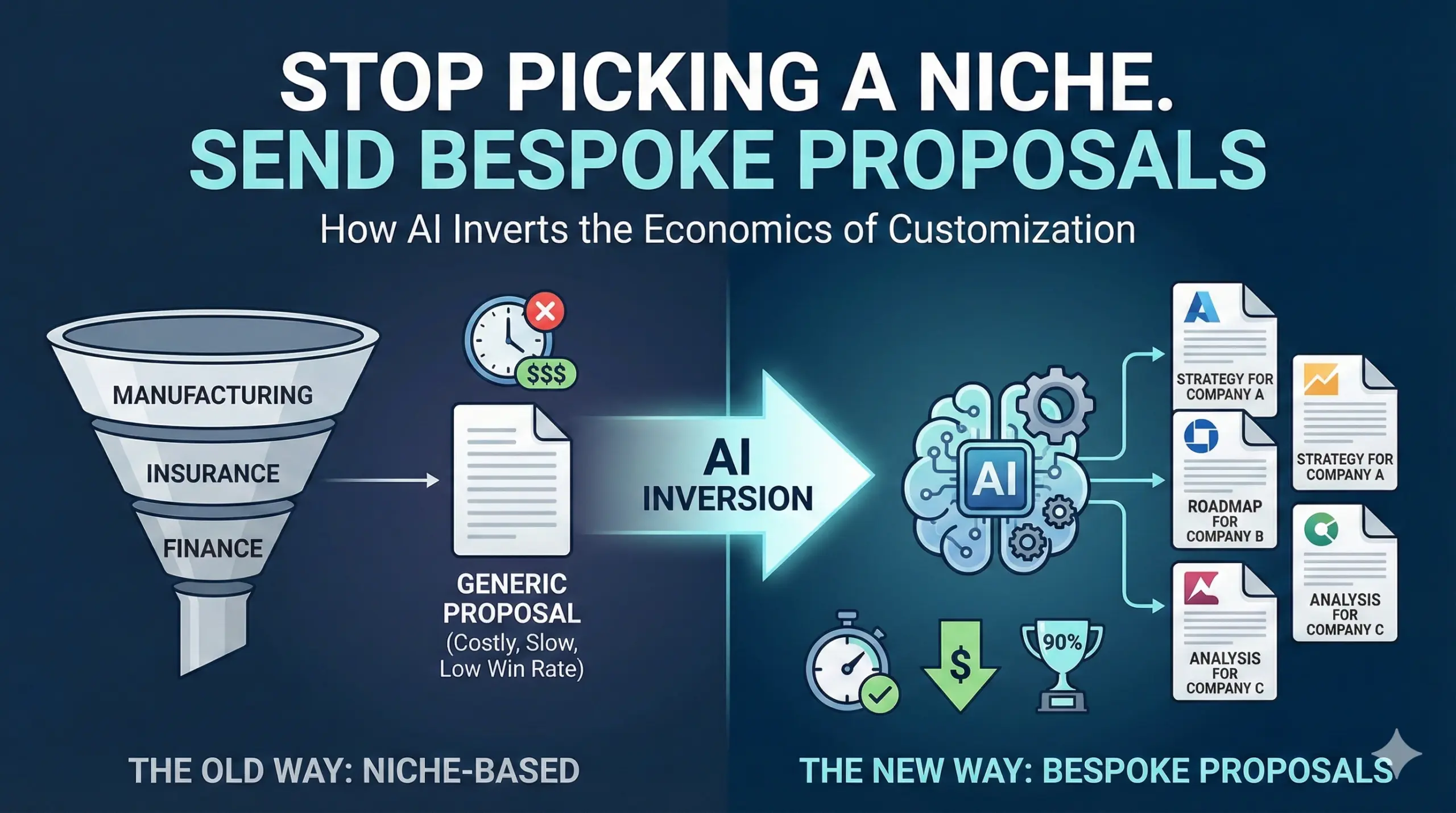
Stop Picking a Niche. Send Bespoke Proposals Instead.
How AI inverts the economics of customization—and why your next prospect doesn’t need to fit a segment
📘 Want the complete guide?
Learn more: Read the full eBook here →
Every consultant faces the same conventional wisdom: pick a niche, build one offer, optimize for segment averages. The advice is everywhere, and for decades, it made perfect economic sense.
Then AI changed the math.
What if generating a bespoke 30-page strategy proposal for a single prospect company cost you less than printing business cards? What if customization at scale was cheaper than maintaining generic sales materials?
Welcome to the inversion.
The Differentiation Crisis Nobody Talks About
If you’re an AI consultant in late 2025, you’re competing in a field where everyone has “AI expertise” in their bio. The gold rush phase is over. The differentiation crisis is here.
You can’t compete on credentials anymore—everyone has the certifications. You can’t compete on “we use AI”—that’s table stakes. And if you’re competing on price, you’ve already lost.
The traditional playbook says: pick a niche. Position yourself narrowly. Build reputation in one vertical. Become the “AI for manufacturing” firm or the “AI for insurance” consultant.
But here’s the problem: you’re still optimizing for averages. Your “manufacturing niche” pitch is designed for the statistical center of that market. When a specific company shows up—with their specific constraints, their specific legacy systems, their specific organizational culture—your positioning either doesn’t quite fit, or you’re customizing on the fly and pretending you had it figured out all along.
The real question isn’t “which niche should I pick?” It’s “why am I still trying to fit companies into boxes instead of demonstrating I understand them individually?”
The Economics Flip: Why This Works Now
Traditional market segmentation wasn’t a strategy—it was a cost-reduction compromise. You couldn’t afford to research and customize for every prospect, so you found the largest groups with similar needs and built one offer.
AI inverts this equation completely.
The Old Economics (Pre-AI)
Custom proposal development:
- Research company background: 6-8 hours
- Analyze industry context: 4-6 hours
- Develop custom strategy: 8-10 hours
- Write and format proposal: 8-12 hours
- Total time: 26-36 hours of senior consultant time
- Opportunity cost: ~$5,000 per proposal
Result: You can’t afford to do this on spec. You only write custom proposals for qualified leads who requested them. Win rate: 20-30% (industry standard).
The New Economics (With AI)
AI-enabled proposal generation:
- Frameworks compiled once (one-time investment): 40-60 hours
- Per-company research (AI-automated): 2 hours human oversight
- Proposal generation (AI from frameworks): 3-5 hours human refinement
- Total time: 5-7 hours per proposal (after initial framework investment)
- Cost: ~$200-500 in compute + human oversight
Result: You CAN afford to generate proposals on spec, as your opening move. Early data shows win rates of 60-90% with properly customized proposals.1,2
The Numbers Don’t Lie
What Changed?
The constraint that made segmentation necessary—prohibitive customization costs—no longer exists. McKinsey found that personalization typically drives 10-15% revenue lift, with company-specific results ranging from 5-25%.6 The research is clear: 71% of consumers expect personalization, and 76% express frustration when they don’t receive it.6
But it’s not just consumer expectations. The competitive advantage itself has shifted from economies of scale to economies of specificity.7 You’re no longer winning by being repeatable—you’re winning by being precisely relevant.
The Proposal Compiler Pattern
Here’s the systematic approach that makes this work:
Step 1: Compile Your Frameworks Once
This is the one-time investment. Create two core documents:
frameworks.md
Encode your proprietary thinking—the intellectual property that makes your consulting valuable:
- Your diagnostic frameworks (how you assess AI readiness, risk, ROI)
- Your implementation patterns (phases, success criteria, common pitfalls)
- Your evaluation methods (how you decide what to recommend)
- Decision trees and checklists
marketing.md
Your positioning and point of view:
- Who you’re for (and who you’re NOT for)
- What you believe about AI implementation
- What you fight against (chatbot-first thinking, tool-chasing, etc.)
- Your differentiation (what makes your approach unique)
Why this matters: These documents become your “compiler.” You build them once, then recompile them for each prospect. The frameworks stay stable; the application varies.
Step 2: Research the Company (AI-Automated)
For each target company, use AI to conduct deep research:
- Company background: Revenue, size, industry, recent changes, strategic priorities
- Financials: Public reports, growth trajectory, cost structure
- Organizational context: Leadership team, recent hires, company culture signals
- Competitive positioning: Where they sit in their industry, who they compete with
- Technology landscape: Current systems, recent tech investments, integration challenges
This research becomes the “case study”—the specific context against which your frameworks will be applied.
Step 3: Generate the Proposal (Framework Application)
Now the AI applies your compiled frameworks to this specific company context. The proposal structure:
Section 1: Executive Summary (1-2 pages)
What you discovered about their business, why now matters, what you’re recommending at a high level.
Section 2: Research Findings (4-6 pages)
Demonstrate depth: show what you learned about their company, industry, and strategic position. Include specific data, not generic observations.
Section 3: Framework Application (8-12 pages)
Apply your proprietary frameworks to their situation. This is where you show systematic thinking—not “here’s what I’d do,” but “here’s how we evaluated your options using [Three-Lens Framework / Enterprise AI Spectrum / your approach].”
Section 4: Recommendations (6-8 pages)
Specific, actionable strategy: what to build, in what order, with what governance, and why these choices over alternatives.
Section 5: Rejected Alternatives (4-6 pages)
This is the trust multiplier. Show what you considered and why you didn’t recommend it. “We looked at implementing a chatbot-first strategy but rejected it because…” This demonstrates rigor and prevents the objection “did you consider X?”
Section 6: Implementation Approach (4-6 pages)
Phases, timeline, resource requirements, success criteria. Make it concrete enough to be credible, flexible enough to adjust in engagement.
Step 4: Refine and Send
Human oversight for:
- Fact-checking company details
- Ensuring frameworks are applied correctly
- Tone and voice consistency
- Removing obvious AI-generation artifacts
Total time after framework compilation: 5-8 hours. That’s the economic inversion—bespoke proposals are now cheaper than maintaining generic sales decks.
Why This Works: Three Mechanisms
1. The Proposal IS the Proof
Most consultants tell prospects “we’re good at AI strategy.” You’re showing them. The 30-page document sitting in front of them—researched, customized, demonstrating systematic thinking—is your AI capability on display.
This is meta-credibility: the way you sold them is the way you’ll serve them. If your proposal shows depth, rigor, and custom thinking, that’s evidence of what working with you looks like.
2. The John West Principle
The famous British seafood advertising campaign: “It’s the fish that John West rejects that makes John West the best.”
Showing what you DIDN’T recommend—and why—builds trust in a way that hiding your reasoning never can. It proves you actually thought through alternatives instead of having one hammer for every nail.
When you document rejected ideas (Section 5 of the proposal), you’re demonstrating:
- You explored broadly, not narrowly
- You applied judgment, not just templates
- You understand trade-offs
- You’re intellectually honest (not just selling what you know how to build)
3. Marketplace of One Economics
Research from multiple sources confirms the economic shift:
- Account-Based Marketing (ABM): 87% of marketers report higher ROI than traditional marketing8
- Personalized email campaigns: 122% higher ROI than non-personalized9
- Custom vs. generic AI solutions: 2x performance advantage10
- One-to-one marketing: 15-20% increase in campaign ROI11
The pattern is consistent: specificity beats averages when the cost of specificity drops to near-zero.
What Changes If You Adopt This
For You as a Consultant
Sales motion inverts: Instead of “qualify leads → respond to RFPs → hope you win,” you lead with value. Your proposal creates the conversation. Prospects who read 30 pages of your thinking about their business are pre-qualified by investment of attention.
Differentiation becomes automatic: You’re not the “AI for X industry” consultant anymore. You’re the consultant who already understood their specific business before the first call.
Proposals become assets, not expenses: With 5-8 hour generation time, you can afford to send 50-100 proposals per year instead of 10-15. The volume itself becomes a competitive advantage.
For Your Business Model
| Factor | Traditional (Niche-Based) | AI-Enabled (Bespoke) |
|---|---|---|
| Proposals/Year | 10-20 (constrained by senior time) | 50-100+ (AI-automated) |
| Cost/Proposal | ~$5,000 (opportunity cost) | ~$300 (compute + oversight) |
| Win Rate | 20-30% (industry standard) | 60-90% (custom, researched) |
| Positioning | Optimized for segment average | Optimized for specific company |
| Differentiation | Vertical expertise, credentials | Demonstrated understanding |
How to Build Your First One This Week
If this resonates, here’s your starting point:
Monday-Tuesday: Framework Compilation
Create frameworks.md:
- List your 3-5 core frameworks (how you assess AI projects, decide priorities, measure success)
- Write down your diagnostic questions (what you ask to understand a business)
- Document your implementation patterns (phases you typically recommend)
Create marketing.md:
- Who you’re for (company size, stage, industry if relevant)
- Who you’re NOT for (important for filtering)
- What you believe (your POV on AI implementation)
- What differentiates you
Wednesday-Thursday: Research System
Pick a target company and use AI to research:
- Public financials and filings
- Leadership team and recent changes
- Industry context and competitive position
- Recent news, press releases, job postings
Compile this into a “case study” document—the board position for your frameworks.
Thursday-Friday: Generate Proposal
Use AI to apply your frameworks to the case study. Structure:
- What we learned about your business (research findings)
- How we analyzed your options (framework application)
- What we recommend (specific strategy)
- What we rejected and why (alternatives considered)
- How to implement (roadmap)
Human refinement: Fix any factual errors, ensure voice consistency, remove generic AI language.
Friday Afternoon: Send It
Not as a response to an RFP. As your opening move. Subject line: “Strategic AI analysis for [Company Name] (on spec)”
Body: “I spent some time researching [Company] and thought through how AI might help with [specific challenge you identified]. No strings attached—this analysis is yours whether we talk or not. If the thinking resonates, let’s discuss implementation. If not, I hope it’s useful anyway.”
The proposal demonstrates your capability WHILE selling. That’s the inversion: you’re not selling to earn the right to demonstrate—you’re demonstrating to earn the conversation.
What You’re Really Competing On
This isn’t about “better proposals.” It’s about a fundamental shift in what creates competitive advantage.
The old game: pick a niche, build reputation, compete on credentials.
The new game: compile your thinking, demonstrate understanding, compete on depth.
The economics have inverted. Customization at scale is now cheaper than maintaining generic materials. Bespoke proposals outperform templated approaches by 2-4x in win rates. And prospects increasingly expect—even demand—evidence that you understand their specific situation, not just their industry segment.
You don’t need to pick a niche. You need to compile your frameworks and start sending bespoke proposals.
The fish you reject will make you the best.
Start With Frameworks
Create frameworks.md this week. Write down your 3-5 core thinking frameworks in Markdown. That’s your compiler. Everything else is recompilation.
The constraint that justified segmentation—prohibitive customization costs—no longer exists. The competitive advantage has shifted from economies of scale to economies of specificity.
Don’t optimize for averages. Optimize for understanding.
References
- Boutique Consulting Club. “Win Rate Analysis.” www.boutiqueconsultingclub.com/blog/win-rate — “My proposal to win rate in the past years is close to 90%, and for one key segment of my audience (UK-based consulting firms with 2-3 partners) it is 95%.”
- Boutique Consulting Club. “Win Rate Analysis.” www.boutiqueconsultingclub.com/blog/win-rate — “I know a lot of consultants whose proposal to win rate is around the 20-30% mark.”
- Consulting Success. “Consulting Business Models.” www.consultingsuccess.com/consulting-business-models — “One Clarity Coaching™ member reduced proposal development time by 70% while improving win rates by using AI to analyze client needs and customize recommendations.”
- Code Conspirators. “Engineering Firm Wins 78% More Projects Using AI Proposal Automation.” www.codeconspirators.com/engineering-firm-wins-78-more-projects-using-ai-proposal-automation/
- Aura. “Consulting Proposals Guide.” blog.getaura.ai/consulting-proposal — “According to the 2024 Consultant Survey Report, only 30% of consultants reported winning proposals submitted during an RFP process.”
- McKinsey & Company. “The Next Frontier of Personalized Marketing.” www.mckinsey.com/capabilities/growth-marketing-and-sales/our-insights/unlocking-the-next-frontier-of-personalized-marketing — “71% of consumers now expecting personalized experiences and 76% expressing frustration when they don’t receive them.”
- LeverageAI. “The Team of One: Why AI Enables Individuals to Outpace Organizations.” leverageai.com.au/the-team-of-one-why-ai-enables-individuals-to-outpace-organizations/ — “The economic advantage has inverted from economies of scale to economies of specificity—and solo operators are winning.”
- Revv Growth. “ABM vs Traditional Marketing.” www.revvgrowth.com/abm/vs-traditional-marketing — “According to research, 87% of marketers report that ABM delivers higher ROI than traditional marketing.”
- Amra & Elma. “Marketing Personalization ROI Statistics 2025.” www.amraandelma.com/marketing-personalization-roi-statistics/ — “Personalized email campaigns have proven to generate 122% higher ROI than non-personalized campaigns.”
- LeverageAI. “The AI Think Tank Revolution.” leverageai.com.au/the-ai-think-tank-revolution-why-95-of-ai-pilots-fail-and-how-to-fix-it/ — “Custom solutions outperform generic 2x. No playbook can capture this—needs discovery, not template.”
- Contentful. “One-to-One Marketing.” www.contentful.com/blog/one-to-one-marketing/ — “Data-driven marketing, a key aspect of one-to-one marketing, can lead to a 15-20% increase in campaign ROI.”
Discover more from Leverage AI for your business
Subscribe to get the latest posts sent to your email.