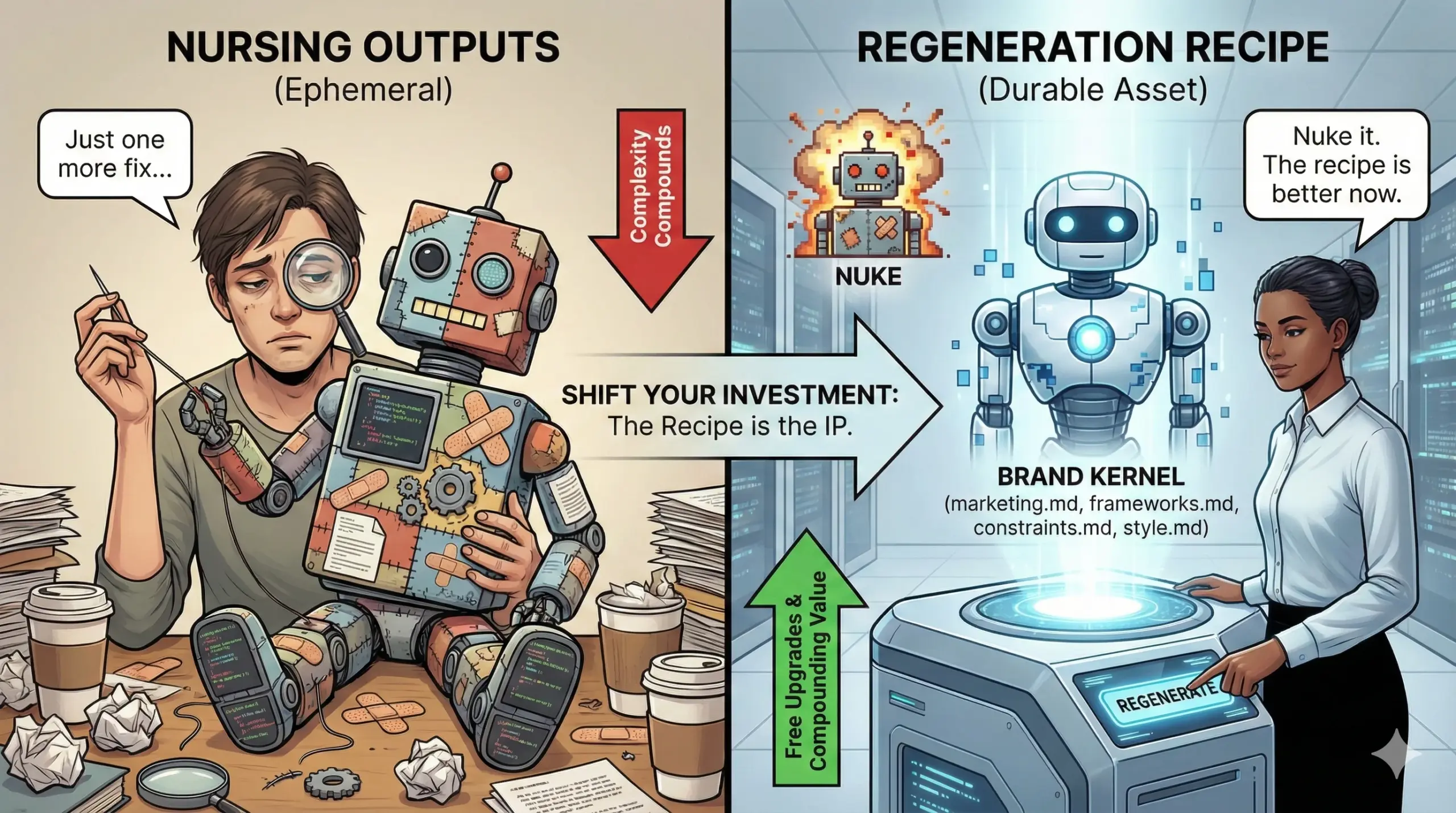
Stop Nursing Your AI Outputs. Nuke Them and Regenerate.
Why the durable asset in AI-assisted systems is the generation recipe, not the output—and how to shift your investment accordingly.
📘 Want the complete guide?
Learn more: Read the full eBook here →
TL;DR
- AI outputs (code, proposals, workflows) should be treated as ephemeral—regenerable from a better recipe
- The durable asset is the generation recipe: your frameworks, marketing position, constraints, and builder specifications
- After ~3-5 patches, regeneration becomes cheaper than continued nursing—the crossover point
- Model upgrades give you free value: same recipe produces better outputs with newer models
- Build a Brand Kernel (marketing.md + frameworks.md + constraints.md + style.md) as your reusable IP
The Confession
I built a proposal compiler that worked. Then I spent three days making it worse.
The system was supposed to generate bespoke consulting proposals—tailored to each prospect’s specific situation, industry, and pain points. And it did. Mostly. The outputs were solid 7s, maybe 8s on a good day.
So I started iterating. Added a clause here. Tweaked the structure there. Fixed a phrasing issue. Then another. By day three, I’d accumulated fifteen patches and the proposals had somehow gotten worse.
That’s when it hit me: I was nursing the outputs instead of fixing the recipe.
I’d forgotten to compile my marketing positioning (marketing.md) and my consulting frameworks (frameworks.md) into the builder itself. Every output was starting from scratch, missing the accumulated judgment I’d encoded in those files. No wonder each proposal felt slightly off-brand. The builder didn’t know my brand.
“In ephemeral development, code is the output, not the solution. The value is in the context, design, and guardrails that surround it.”
— Matt Baldwin, “The Premise: Code Is Ephemeral”
The fix wasn’t more patches. It was nuking the outputs, updating the recipe to include my kernel files, and regenerating from a better foundation.
The Pattern Most People Miss
Here’s the uncomfortable truth: most teams treat AI-generated outputs as the asset. They patch code. They edit proposals. They refine workflows. Each iteration makes the output slightly better—and slightly more divorced from any coherent design.
This made sense in the old world. Before AI, regeneration was expensive. A human had to rewrite everything. Patching was the only economical option.
That constraint has flipped.
AI can regenerate complex outputs—code, proposals, content, workflows—in seconds, at near-zero marginal cost. But human judgment? That’s still expensive to encode. When your insight lives only in a patch, it’s trapped in that one output. When it lives in the recipe, AI can apply it infinitely.
The Two-Stage Compiler Model
Every effective AI-assisted system is actually a two-stage compiler—but most people only run stage two:
Stage 1: Compile Your Worldview
Input: Your marketing position, frameworks, patterns, anti-patterns, constraints, style guidelines
Output: A builder that thinks in your dialect
Stage 2: Compile Their Context
Input: The specific situation, client, or use case
Output: A tailored artifact (proposal, code, workflow)
Most people skip straight to Stage 2. They prompt AI with the immediate context and hope for the best. When the output is off, they patch it. Then patch it again. Each patch encodes judgment that should have been in Stage 1.
“Specs should live longer than the code. Code becomes a by-product of well-written specifications.”
— Spec-Driven Development, Medium
The Economics Have Inverted
Let me show you the numbers that convinced me to stop nursing outputs.
The Cost of Patching
GitClear analyzed over 153 million lines of code and found a disturbing trend:2
- Code churn doubled between 2021 and 2024—lines reverted or updated within two weeks of being written
- 4x increase in code duplication—AI-generated code violates DRY at much higher rates
- For the first time in history, copy/paste exceeded refactoring as the primary code reuse pattern
This is what happens when you nurse outputs: complexity compounds. Each patch adds weight. The system becomes harder to reason about, harder to change, harder to improve.
A bug fixed in the specification costs $100. That same bug, left to accumulate as technical debt in production, costs $10,000. The 100x multiplier isn’t a metaphor—it’s the measured reality of software maintenance economics.
The Cost of Regeneration
Now consider the alternative. When you update the recipe and regenerate:
- The output incorporates all your accumulated judgment, not just the latest patch
- No archaeological dig through fifteen layers of edits
- New team members can read the recipe to understand intent
- Model upgrades produce better outputs automatically
That last point deserves emphasis.
The Free Upgrade Effect
When Anthropic released Claude Sonnet 4.5, teams using specification-first approaches got an instant boost:4
| Metric | Improvement |
|---|---|
| Vulnerability intake time | 44% faster |
| Accuracy | 25% better |
| Planning performance | 18% increase |
| Price | Same |
Same recipe. Better model. Better outputs. No additional work.
If your value is encoded in patches on outputs, you get none of this. You’re stuck with the capabilities of whatever model generated the original. But if your value is encoded in the recipe, every model upgrade is free improvement.
The Crossover Point
Not every edit needs a full regeneration. Sometimes a quick fix is the right call.
The question is: where’s the crossover point?
Based on my experience and the research, it’s around 3-5 patches. After that, you’ve encoded enough judgment in the output that it should be in the recipe instead.
The Crossover Test
Ask yourself: “If I had to regenerate this output from scratch tomorrow, would I remember to include all these changes?”
If the answer is no, your patches have become tribal knowledge trapped in an artifact. Time to update the recipe.
What Belongs in Patches vs. Recipes
| Patch the Output | Update the Recipe |
|---|---|
| One-off typo fix | Recurring phrasing issue |
| Client-specific customization | Industry-wide pattern |
| Quick formatting adjustment | Structural template change |
| Immediate deadline, no time | You’ve made this fix twice before |
The rule of thumb: if you’re fixing the same category of issue multiple times, it belongs in the recipe.
The Brand Kernel: Your Regeneration Recipe
So what goes in the recipe? I call it the Brand Kernel—the set of meta-files that encode your worldview and judgment.
The Four Essential Files
1. marketing.md — Your positioning and voice
- Who you serve (and who you don’t)
- The problem you solve in their language
- Your differentiation and point of view
- Voice and tone guidelines
2. frameworks.md — Your intellectual property
- Named frameworks and methodologies
- Diagnostic patterns you apply
- The structure of how you think about problems
3. constraints.md — Your guardrails
- What you never do (anti-patterns)
- Compliance requirements
- Brand red lines
- Technical or operational limits
4. style.md — Your aesthetic
- Formatting preferences
- Structural patterns
- Language rules (active voice, no jargon, etc.)
The Kernel is the IP
Here’s the insight that changed how I think about AI-assisted work: the kernel is the intellectual property, not the outputs.
Outputs are proof the kernel works. They’re the “binary” compiled from your “source code.” If someone copies one of your proposals, they got one proposal. If they got your kernel, they could generate infinite proposals in your style.
The Inversion in Practice
The Design-Compiler Pattern makes this inversion explicit:5
| Dimension | Old Pattern | New Pattern |
|---|---|---|
| Primary artifact | The output (code, proposal) | The specification (kernel + design) |
| Documentation role | Afterthought describing output | Input to generation |
| Source of truth | What the output does | What the spec requires |
| When they diverge | Update docs to match output | Fix spec, regenerate output |
| Learning captured in | Patches and comments | Kernel and design files |
| Review focus | Line-by-line output review | Design review before generation |
“The design document persists across changes that would normally require major rework: model upgrades, team changes, refactoring, bug fixes.”
— A Blueprint for Future Software Teams
When bugs are found in the new pattern, you don’t nurse the output. You ask: “What did the specification miss?” Then you update the spec and regenerate. The learning lives in the recipe, not trapped in one artifact.
The Infrastructure as Code Analogy
If this pattern sounds familiar, it should. DevOps figured this out years ago with Infrastructure as Code.
“Terraform builds on the concept of immutable infrastructure: servers are never modified after they’re deployed. If something needs to be updated, new servers are built from a common image, and old servers are discarded.”
— Codefresh, IaC with Terraform
In IaC:
- Configuration files (recipes) are versioned and durable
- Infrastructure instances are disposable and regenerable
- You never SSH into a server to patch it—you update the config and redeploy
The same principle applies to AI-assisted work:
- Kernel files (recipes) are versioned and durable
- Generated outputs are disposable and regenerable
- You don’t edit the output—you update the kernel and regenerate
The constraint that made “patch in place” sensible—regeneration being expensive—has evaporated. The discipline that made DevOps teams faster (immutable infrastructure) now applies to any AI-assisted workflow.
The Counter-Evidence (And Why It Still Supports the Thesis)
Here’s what skeptics point to: developer trust in AI outputs is declining.6
- Only 29% of developers now trust AI tool outputs (down from 40% a year ago)
- 66% report spending more time fixing “almost-right” AI code than they saved in initial generation
This sounds like a case against AI. It’s actually a case against nursing.
The “almost right but not quite” phenomenon is exactly what happens when you generate from underspecified recipes. The AI is missing context—your frameworks, your constraints, your patterns. So it produces something plausible but wrong in ways that require detailed human review to catch.
The solution isn’t to abandon AI. It’s to invest more in the recipe so the initial generation is right, not “almost right.”
The Real Problem
66% of developers spending more time fixing AI code than saved isn’t a problem with AI generation.
It’s a problem with specification quality.
Better recipes → better first-pass outputs → less fixing → actual productivity gains.
How to Start
If you’re currently nursing outputs, here’s the migration path:
Week 1: Audit Your Patches
Look at the last 10 edits you made to AI-generated outputs. Ask: which of these encode judgment that should be reusable? Group them into categories.
Week 2: Create Your Kernel
Start with the four files: marketing.md, frameworks.md, constraints.md, style.md. They don’t need to be perfect. Rough captures beat no captures.
Week 3: Test Regeneration
Take one of your patched outputs and try regenerating it from your new kernel. Compare the result. What’s missing? Update the kernel.
Ongoing: Apply the Crossover Rule
For new work: patch small one-offs, but after 3-5 patches, ask whether you’re encoding judgment that belongs in the recipe.
The Next Time You Find a Bug
Ask yourself: Should I patch the output, or fix the recipe?
Your answer determines whether your system compounds—or just accumulates complexity.
The Bottom Line
AI has inverted the economics of artifact maintenance. Regeneration is now cheap; human judgment is still expensive to encode.
The teams that thrive in this environment will be the ones that recognize which layer to invest in:
- Invest heavily in the kernel—your marketing position, frameworks, constraints, and style
- Invest lightly in individual outputs—they’re proof the kernel works, not the product itself
- Regenerate when the kernel improves, rather than nursing old outputs to incorporate new thinking
Your competitors who figure this out will have systems that compound. Their kernel gets better, which makes every future output better, which generates feedback that improves the kernel further.
Your competitors who keep nursing outputs will have systems that accumulate. More patches, more complexity, more drift from intent. Every new output starts from scratch because the lessons are trapped in old artifacts.
Which system would you rather have in 12 months?
“Code has always been temporary. We deploy it, replace it and rewrite it sometimes within hours or days. Yet most organizations still treat it like a permanent asset, investing in its preservation instead of its adaptability.”
— Matt Baldwin, “The Premise: Code Is Ephemeral”
Stop nursing your AI outputs.
Nuke them and regenerate from a better recipe.
References
- McKinsey & Company. “AI for IT modernization: faster, cheaper, and better.” mckinsey.com/capabilities/quantumblack/our-insights/ai-for-it-modernization-faster-cheaper-and-better — “The result was an improvement in code modernization efficiency and testing by more than 50 percent.”
- GitClear. “AI Copilot Code Quality: 2025 Data Suggests Downward Pressure on Quality.” gitclear.com/ai_assistant_code_quality_2025_research — “Code churn is projected to double in 2024 compared to its 2021, pre-AI baseline… 4x more code cloning.”
- Software Improvement Group / Forbes. “Technical debt and its impact on IT budgets.” softwareimprovementgroup.com/technical-debt-and-it-budgets — “If software bugs are addressed early in the SDLC… they can cost as little as $100 to fix. However, if that same bug is left in the system as technical debt, the cost to fix it soon escalates to $10,000.”
- Anthropic. “Claude Sonnet 4.5.” anthropic.com/claude/sonnet — “Claude Sonnet 4.5 reduced average vulnerability intake time by 44% while improving accuracy by 25%… For Devin, planning performance increased by 18%.”
- LeverageAI. “A Blueprint for Future Software Teams.” leverageai.com.au — “The design document is no longer an afterthought. It’s the input. The specification. The source of truth.”
- Stack Overflow Developer Survey / AskFlux. “AI Generated Code: Revisiting the Iron Triangle in 2025.” askflux.ai — “Only 29% of developers trust AI tool outputs now, down from 40% just a year ago. And 66% report spending more time fixing ‘almost-right’ AI generated code than they save.”
Discover more from Leverage AI for your business
Subscribe to get the latest posts sent to your email.