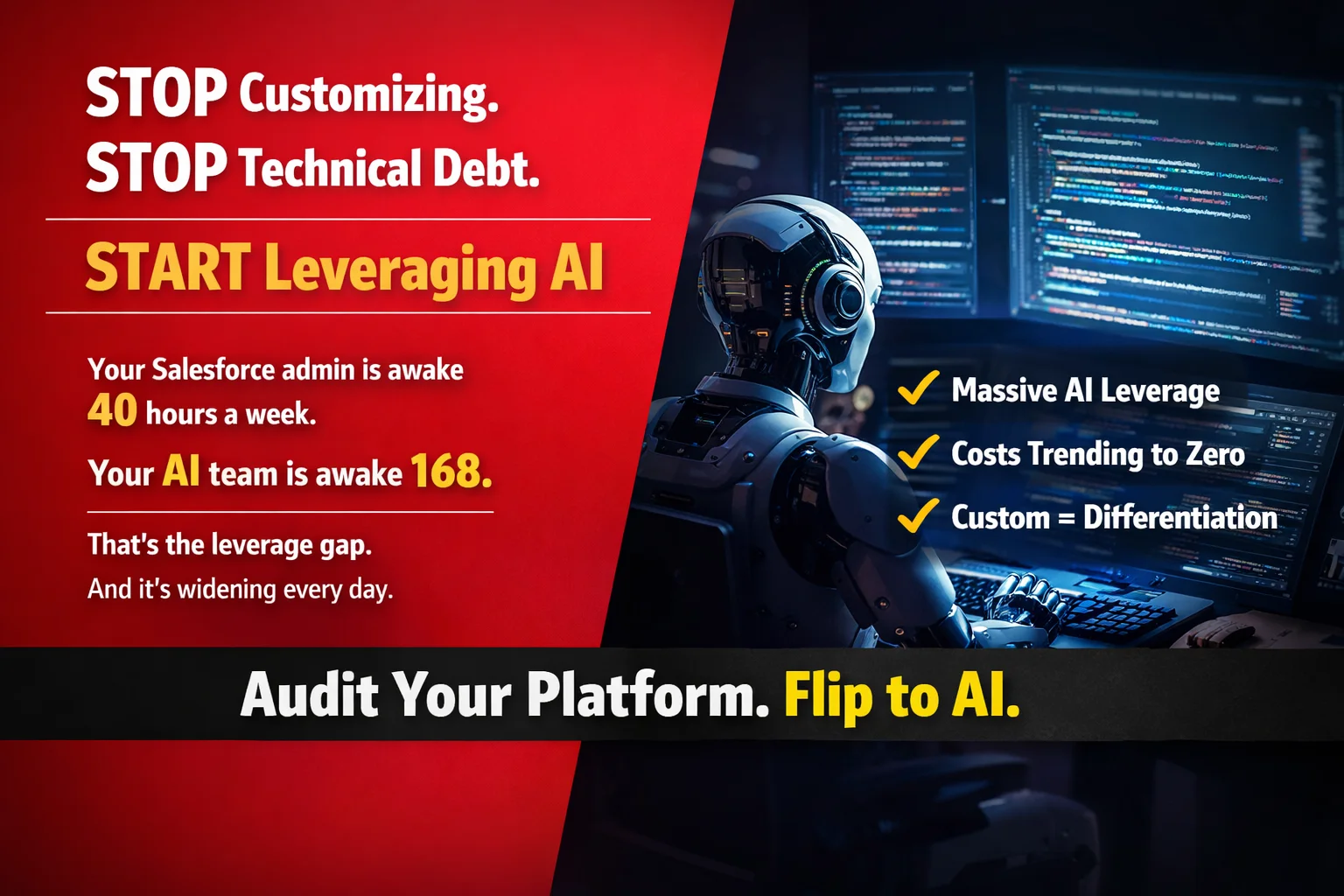
STOP Customizing, STOP Technical Debt, START Leveraging AI
Why your platform customization spend has zero AI leverage — and what to do instead.
📘 Want the complete guide?
Learn more: Read the full eBook here →
Your AI team is awake 168.
That’s the leverage gap. And it’s widening every day.
Andrej Karpathy — one of the most respected AI researchers alive — just announced he went from 80% manual coding to 80% AI-generated code in a matter of weeks. “This is easily the biggest change to my basic coding workflow in ~2 decades of programming,” he wrote. “It happened over the course of a few weeks.”1
The Vercel CTO put it more bluntly: “The cost of software production is trending towards zero.”2
Meanwhile, you’re paying $200K/year for Salesforce, plus $150K for two admins, plus $300K for implementation partners, plus $100K in annual consulting retainers.3
That’s nearly a million dollars in year one — to make their generic platform fit your specific workflows.
Here’s the uncomfortable question: Where is AI in that equation?
The answer: Nowhere. AI can barely touch Salesforce configuration. Every dollar you spend on platform customization offers zero AI leverage.
The Stupidity Tax
Let me name what’s actually happening.
You bought software “made for the average.” Then you spent a fortune making it un-average. You hired consultants to translate your requirements into what the platform allows. You hired admins to maintain those translations. You paid integration partners to connect it to your other systems.
And you called this a “platform investment.”
But here’s what you actually did: You built custom software — badly — inside someone else’s prison.
- Paying full price for generic software
- Paying again to make it specific
- Getting zero AI leverage in return
If you’re spending more to customize software than on the software itself, the economics have inverted. And you’re on the wrong side.
Why Platform Configuration Has No AI Leverage
Here’s what Karpathy described about his shift to AI-assisted development:
“I am mostly programming in English now, a bit sheepishly telling the LLM what code to write… in words. It hurts the ego a bit but the power to operate over software in large ‘code actions’ is just too net useful.”
— Andrej Karpathy1
AI is brilliant at code. It understands codebases. It can navigate them, refactor them, test them, improve them. In fact, 41% of all code written in 2025 is now AI-generated.4
But Salesforce configuration? ServiceNow workflows? HubSpot automations?
AI can barely help. Why? Proprietary configuration languages. Closed ecosystems. No version control in any meaningful sense. No automated testing infrastructure. No CI/CD pipelines.
Platform configuration debt accumulates without any of the tools we’ve built over 50 years of software engineering.
| Platform Configuration | Spec-Driven Code | |
|---|---|---|
| AI can help | Barely | Massively (80%+) |
| Version control | Primitive | Git, full history |
| Testing | Manual, hopeful | Automated, systematic |
| Change cost over time | Escalates | Flat (regenerate) |
| Model upgrade benefit | Zero | Free improvement |
Every dollar you pour into platform configuration doesn’t benefit from model improvements, doesn’t compound with your team’s learning, doesn’t transfer to your next system, and locks you deeper into someone else’s roadmap.
Every dollar you pour into spec-driven AI development gets better as models improve (for free), compounds as your team masters AI tooling, transfers to any future system, and builds assets you own.
The Three Tiers: What to STOP vs What to START
Not all software is the same. Here’s the framework for deciding what stays “buy” and what flips to “build”:
Tier 1: Commodity Plumbing — Keep Buying
- Examples: Auth0, Stripe, Twilio, SendGrid, Cloudflare
- Characteristics: Real-time critical, deeply operational, cheap per-unit, zero customization anyway
- The test: You’re not fitting them to your business — you’re plugging them in
These stay. They’re efficient, cheap, and you aren’t customizing them anyway. The plumbing works.
Tier 2: Horizontal Platforms — The Flip Zone
- Examples: Salesforce, HubSpot, ServiceNow, Workday
- Characteristics: Expensive base cost, massive customization projects, consultant armies, internal admin staff
- The dirty secret: You’re not paying for software — you’re paying to make generic software fit your specific case
This is where the economics have inverted. If you’re going to customize it, parameterize it, pay consultants to configure it, and hire staff to maintain it — you may as well throw it out and go AI coding.
Tier 3: Industry Verticals — Also Flip Zone
- Examples: “Insurance CRM,” “Healthcare scheduling,” “Legal practice management”
- Characteristics: Claims to fit your industry but is still 60-70% generic
- The vendor promise: “Built for your industry!”
- The reality: “Built for the average of your industry”
STOP Playing the Averages
Here’s the deeper problem with SaaS platforms.
When you buy Salesforce, you’re buying software designed for the average of all Salesforce customers. When you buy a vertical industry solution, you’re buying software designed for the average of your industry.
You’re playing the averages.
But your competitive advantage doesn’t come from being average. It comes from being different. From serving your specific customers in your specific way with your specific workflows.
“If you and your competitor are all using the same service, you have no edge over each other. Their AI and your AI against each other — I don’t know who’s going to win.”
— Mehdi Paryavi, CEO, International Data Center Authority5
Using the same SaaS as your competitors = same capabilities = no differentiation.
Building custom with AI = your specific workflows = competitive advantage.
STOP Playing Safe
“No one got fired for buying Salesforce.”
That was true. Past tense.
Here’s what’s changing:
- SaaS inflation: Running 5x faster than general inflation (12.2% vs 2.4% for G7 countries)6
- AI coding capability: 41% of all code now AI-generated; 25% of Y Combinator startups ship 95% AI code4,7
- Development cost collapse: Custom AI development costs have fallen 70-90%8
- Paradigm shift speed: Karpathy’s transformation happened in weeks, not years1
The “safe” choice — buying platforms and customizing them — is becoming the risky choice. You’re investing in systems that can’t benefit from AI improvements, lock you into escalating vendor pricing, accumulate technical debt without solution paths, and offer no competitive differentiation.
Meanwhile, your competitors who are building with AI are getting better every time models improve, paying near-zero marginal cost for new features, shipping in days what takes you months, and building actual competitive advantages.
STOP: Playing Safe
- Zero AI leverage
- Escalating vendor costs (5x inflation)
- Technical debt without solution paths
- Same capabilities as competitors
START: Playing to Win
- Massive AI leverage (80%+ AI-generated)
- Costs trending toward zero
- Regeneration beats patching
- Custom = differentiation
Your Sunk Cost Is Your Spec
Here’s the operational insight that changes everything.
Your current Salesforce implementation IS your requirements document.
- Every custom field = a data requirement
- Every workflow rule = a business rule
- Every report = an output specification
- Every integration = an interface contract
You don’t start from zero. You start from “what we actually built, expressed as platform configuration.”
Export that. Translate it to spec. Regenerate as software you own.
Your sunk cost becomes your asset — not money thrown away, but requirements documented in detail. The consultants who configured your platform effectively wrote the spec for what you actually need.
Now AI can build it. In code. That you own. That you can test. That improves with every model upgrade.
The Overnight Sprint
Here’s what becomes possible when you move from platform configuration to spec-driven development.
Old model (Salesforce change request):
Week 1: Submit request to admin team
Week 2: Requirements gathering meetings
Week 3: Impact analysis (what does this touch?)
Week 4: Development in sandbox
Week 5: Testing, UAT
Week 6: Deploy to production (hopefully)
New model (Spec-driven overnight sprint):
5pm: Business requirement arrives
     ↓ Spec changes drafted
     ↓ AI regenerates affected code
     ↓ Automated tests run
     ↓ PR created with diff + audit trail
9am: Human reviews PR, approves, deploys
Same business outcome. Six weeks → one night.
This isn’t science fiction. Elite developers are already doing this. Theo Brown generated 11,900 lines of code without opening an IDE.9 The creator of Claude Code ships 100% AI-written code.2 Companies are building enterprise-grade products with small teams in months.10
The AI-Enabled Team
The money you’re spending on platform customization already exists. It’s just going to the wrong place.
Instead of:
- 2 Salesforce admins ($150K each)
- Implementation partner ($300K)
- Annual consultant retainer ($100K)
- Integration maintenance ($80K)
Redirect to:
- AI-proficient developers who write specs, not configs
- AI tooling and infrastructure
- Domain expertise that gets encoded into specifications
The difference:
- Platform admins: Linear returns, no AI leverage
- AI-enabled team: 20-100x leverage, compounding with every model improvement
Work towards an AI-first execution team that can power through requirements. Staff who are empowered, not constrained. Who work with AI, not against proprietary configuration languages.
The Harness Is the Moat
One more insight from the frontier.
The people getting the most from AI coding aren’t just using generic tools. They’re building harnesses — domain-specific configurations, workflows, and specifications that make AI dramatically more useful for their specific context.
“The harness is the moat. The harness is the product. The harness is what separates ‘I vibe coded a broken app’ from ‘I built a system that actually works.'”
— Lumberjack11
If you understand your domain — your specific workflows, your specific data models, your specific business rules — you can encode that understanding into specifications that make AI dramatically more powerful than any generic SaaS platform.
Your domain knowledge becomes your competitive advantage. Not your vendor’s generic features.
The Decision
You have a choice.
Path A: Keep customizing platforms
- Zero AI leverage
- Escalating vendor costs (5x inflation)
- Technical debt without solution paths
- Same capabilities as competitors
- Playing safe, playing the averages
Path B: Build with AI
- Massive AI leverage (80%+ AI-generated)
- Costs trending toward zero
- Regeneration beats patching
- Custom = differentiation
- Playing to win
The economics have inverted. The safe choice isn’t safe anymore.
Your Salesforce admin is awake 40 hours a week.
Your AI team is awake 168.
The question isn’t whether to make this shift.
The question is whether you’ll make it before your competitors do.
If AI can’t help you with it, you’re building the wrong way.
Stop funding your vendor’s moat. Start funding your AI leverage.
References
- [1]Andrej Karpathy. “On Agentic Coding.” linkedin.com/pulse/andrej-karpathy-agentic-coding — “I rapidly went from about 80% manual+autocomplete coding and 20% agents in November to 80% agent coding and 20% edits+touchups in December… This is easily the biggest change to my basic coding workflow in ~2 decades of programming and it happened over the course of a few weeks.”
- [2]Pragmatic Engineer Newsletter. “When AI Writes Almost All Code.” newsletter.pragmaticengineer.com — “Opus + Claude Code now behaves like a senior software engineer whom you can just tell what to do… The cost of software production is trending towards zero.” — Malte Ubl, CTO at Vercel
- [3]Ascendix. “Salesforce Implementation Cost Analysis 2025.” ascendix.com/blog/salesforce-implementation-cost — “Junior Salesforce consultants typically charge $60 to $100 per hour, mid-level consultants $100 to $150 per hour, and senior consultants $150 to $250 per hour.”
- [4]Index.dev. “Developer Productivity Statistics 2026.” index.dev/blog/developer-productivity-statistics-with-ai-tools — “41% of all code written in 2025 is AI-generated. This means almost half of a project’s work may involve AI support.”
- [5]Business Insider. “AI Tools Could Make Companies Less Competitive.” businessinsider.com — “If you and your competitor are all using the same service, you have no edge over each other. Their AI and your AI against each other — I don’t know who’s going to win.”
- [6]Vertice. “SaaS Inflation Index 2026.” vertice.one/l/saas-inflation-index-report — “SaaS inflation is now nearly 5x higher than the standard market inflation rate of G7 countries – and is ever increasing whilst the consumer inflation index drops.”
- [7]Lumberjack. “My Predictions for 2026 in AI.” lumberjack.so — “By March 2025, TechCrunch reported that 25% of YC’s Winter 2025 batch had codebases that were 95% AI-generated.”
- [8]Local Research. “Economic Inversion.” — “The economic inversion—where custom AI development costs have plummeted 70-90% while SaaS prices rise—enables SMBs to build owned solutions that surpass SaaS value propositions.”
- [9]Local Research. “Citations Database.” — “Elite developers like Theo GG run 6 parallel Claude Code instances, generating 11,900 lines without opening an IDE.”
- [10]LinkedIn. “Bennett Smith on Vibe Coding.” linkedin.com — “I know several 50M+ ARR companies that are using small dev teams to build and ship enterprise grade products leveraging Codex and agents in months.”
- [11]Lumberjack. “My Predictions for 2026 in AI.” lumberjack.so — “The harness is the moat. The harness is the product. The harness is what separates ‘I vibe coded a broken app’ from ‘I built a system that actually works.'”
Discover more from Leverage AI for your business
Subscribe to get the latest posts sent to your email.