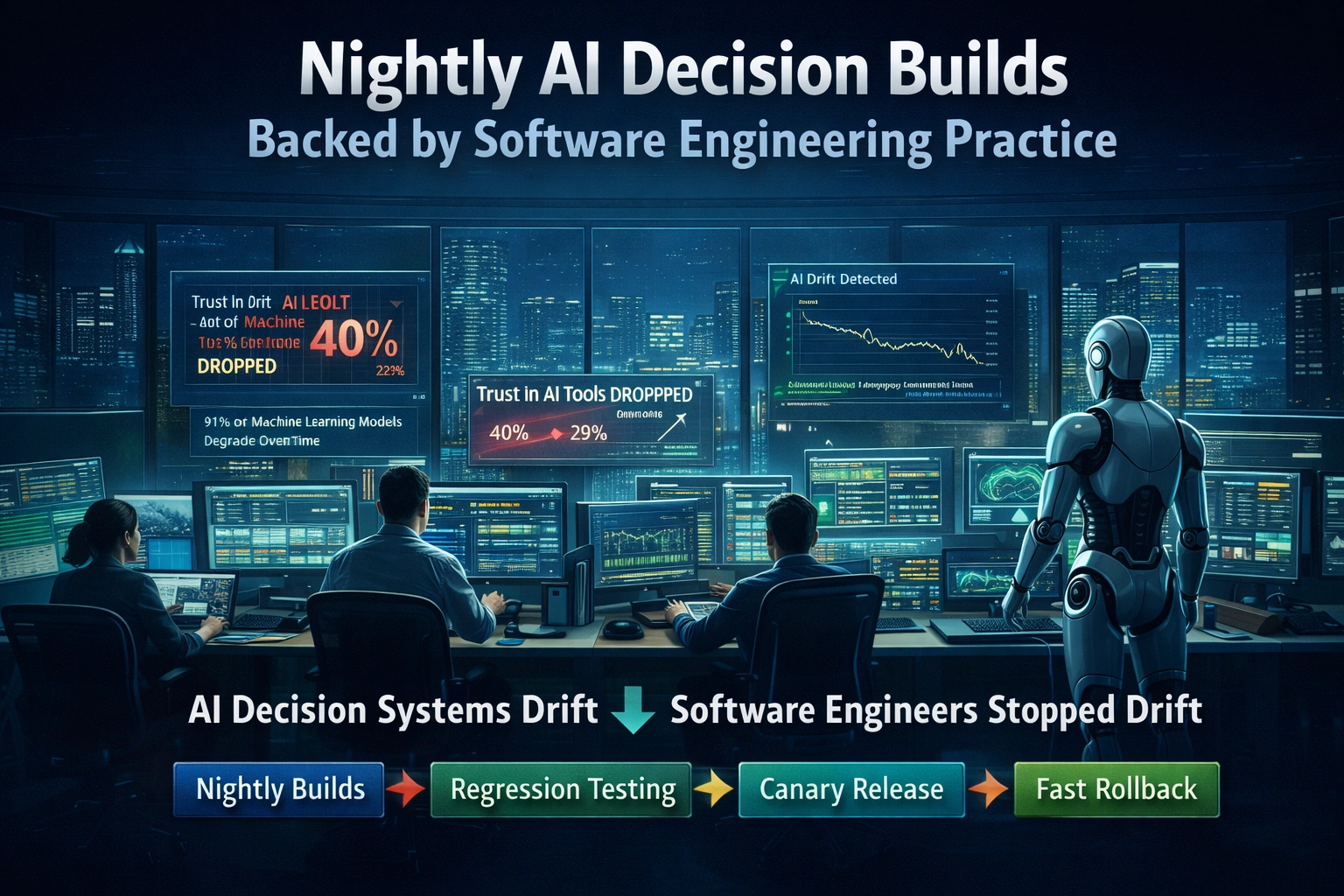
Nightly AI Decision Builds: Backed by Software Engineering Practice
Your AI recommendation engine is a production system that can drift. Software engineers solved this problem 20 years ago.
📘 Want the complete guide?
Learn more: Read the full eBook here →
Trust in AI tools dropped from 40% to 29% in just one year.1 Your AI decision system is probably degrading right now—and nobody’s watching.
Here’s the uncomfortable truth: AI systems don’t fail with error screens. They fail silently. No crashed service. No broken button. Just quietly degrading quality until someone notices the outcomes have gone wrong.2
The good news? Software engineers solved this exact problem two decades ago. It’s called CI/CD: continuous integration, continuous deployment. Nightly builds. Regression tests. Canary releases. The same discipline that transformed software from “ship and pray” to “ship with confidence” applies directly to AI decision systems.
This article shows you how.
In Look Mum, No Hands, we explored what the morning looks like—reps reviewing proposal cards instead of staring at CRM fields. This article goes upstream: how do those proposals get built overnight? How do you test them before reps see them? How do you know they’re not silently drifting?
The Problem Nobody Saw Coming
AI model drift isn’t a bug. It’s an expected operational risk.
“AI model drift refers to the degradation of model performance over time due to changes in data, behavior, or the operating environment. For organizations deploying AI in production, drift should be considered an expected operational risk.”3
A landmark MIT study examining 32 datasets across four industries found that 91% of machine learning models experience degradation over time. Even more concerning: 75% of businesses observed AI performance declines without proper monitoring, and over half reported measurable revenue losses from AI errors.4
When models are left unchanged for six months or longer, error rates jump 35% on new data.4 The business impact becomes impossible to ignore.
What Happens When No One’s Watching
Consider the Workday hiring AI case. The system passed initial fairness audits. Hundreds of employers used it to screen candidates. Then, in May 2025, a federal court certified a class action claiming the AI systematically discriminated against applicants over age 40.
The evidence of automation? One rejection arrived at 1:50 AM, less than an hour after the application was submitted. The speed proved no human could possibly have reviewed it.5
What happened? The AI encountered data it wasn’t trained on. Performance degraded in ways nobody was monitoring. No one caught it until lawyers did.6
Or take the healthcare insurance AI with a 90% error rate on appeals—meaning 9 out of 10 times a human reviewed the AI’s denial, they overturned it. The system was optimized for financial outcomes (denials) rather than medical accuracy, and no one monitored the drift.5
The Playbook Already Exists
Software engineers faced this exact problem. Early software deployments were “ship and pray.” Then came CI/CD: automated pipelines that build, test, and deploy code with continuous validation.
The economics speak for themselves:
- CI/CD adopters report 40% faster deployment cycles and 30% fewer post-production defects7
- Up to 50% reduction in development and operations costs7
- By 2025, 70% of enterprise businesses will use CI/CD pipelines8
- The DevOps market is projected to reach $25.5 billion by 2028 with 19.7% annual growth9
The insight: your AI recommendation engine is a production system that emits decisions. Treat it like one.
The Parallel: Code Systems vs Decision Systems
Every CI/CD concept has a direct equivalent for AI decision systems:
| CI/CD Concept | Decision System Equivalent |
|---|---|
| Nightly Build | Overnight pipeline producing action packs for every account |
| Regression Test | Frozen inputs replayed through new prompts/models |
| Canary Release | 5% of accounts → gradual rollout with monitoring |
| Rollback | Revert to previous model/prompt version |
| Diff Report | What recommendations changed since yesterday and why |
| Quality Gate | Error budget checks before deployment |
| Code Review | SME review of nightly artifacts |
| Feature Flag | Enable/disable recommendation types per segment |
The pattern is exact. Both systems can drift without monitoring. Both benefit from automated testing. Both need instant rollback capabilities. The difference is that software engineering has spent 20 years building the discipline. AI decision systems are still in the “ship and pray” era.
What the Nightly Build Produces
Each overnight run produces artifacts you can store, diff, and review:
- Ranked action packs per account/opportunity (top recommendation + alternatives)
- Evidence bundles (the specific data points that drove each recommendation)
- Rationale traces (why #1 won, why others were rejected)
- Risk/bias flags (and which rule triggered them)
- Execution plans (what tools/actions would be invoked if approved)
This is your equivalent of a compiled binary + logs + test report. Everything is versionable, diffable, reviewable.
The Governance Arbitrage
Here’s the hidden advantage: batch processing transforms real-time AI into design-time AI.
| Approach | Review Opportunity | Governance Model |
|---|---|---|
| Real-time AI | None (decision already made) | Must invent from scratch |
| Nightly Build | Full (artifacts reviewable) | Existing SDLC applies |
Design-time AI produces reviewable, testable, versionable artifacts. Runtime AI requires inventing governance from scratch. The nightly build routes AI value through existing governance pipes.
Regression Testing for Decision Systems
Regression testing validates that changes don’t break existing functionality. For AI decision systems, this means replaying frozen inputs through new models/prompts and comparing outputs.
The economics are compelling: regression testing catches between 40% and 80% of defects that would otherwise escape to production.10 Bugs caught in production cost up to 30× more to fix than those caught during development.11
Building Your Test Suite
For AI decision systems, build three types of test cases:
- Golden accounts: A curated set representing common and tricky scenarios. These are your “if we get these wrong, we have a problem” cases.
- Counterfactual cases: Same account, one variable changed (price sensitivity, industry, role). Detect unexpected sensitivity to inputs.
- Red-team cases: “Tempt the model into bad behavior” scenarios. Test edge cases and potential bias triggers.
Then each nightly build checks:
- Did the top recommendation change? If so, did it change for a good reason?
- Did any policy/risk flags regress?
- Did confidence calibration drift?
- Did segment-level distributions shift? (e.g., Industry A suddenly deprioritized)
You don’t need perfection. You need change detection plus review gates.
Diffing Is the Killer Feature
The most operationally useful artifact is a diff report:
- Accounts whose top recommendation changed since yesterday
- Accounts whose risk rating changed
- Accounts where evidence sources changed (new signals found)
- Accounts where confidence increased (often a smell worth investigating)
This makes human review scalable. Reviewers don’t read everything—they read what changed and why.
Amazon’s 2022 annual report acknowledged that a 1% decrease in recommendation relevance translated to approximately $4.2 billion in potential lost revenue.12 A credit scoring model’s undetected drift cost one bank $4.2M in bad loans over six months. They now monitor performance daily and retrain quarterly, reducing drift-related losses by 85%.13
Diff reports catch these problems before they compound.
Release Discipline: Canaries and Rollback
When you change prompts, models, retrieval logic, or scoring weights—treat it like a software release.
The Canary Pattern
- Deploy to 1-5% of traffic first. A small subset of accounts receives recommendations from the new system.
- Monitor metrics against baseline. Compare decision-making quality, task completion, user acceptance rates.
- Gradually increase (10% → 25% → 50% → 100%) with monitoring at each stage.
- Automated rollback if metrics degrade. Feature flags enable instant rollback without redeployment.
Capital One reported that implementing automated drift detection reduced unplanned retraining events by 73%, while decreasing the average cost per retraining cycle by 42%.14
The principle: the prior version is still active. Immediate rollback is achieved by simply redirecting traffic. No panic. No emergency fixes. Just switch back.
Human Review, Layered
The nightly build enables human review at three levels:
| Level | Who | What They Review |
|---|---|---|
| Micro | BDM/Rep | Accept/edit/reject proposals in daily flow |
| Macro | SME | Sample nightly output for system quality, missing ideas |
| Meta | Governance | Periodic audits of bias, privacy, compliance, tool permissions |
The SME role is especially valuable. They review for “missing ideas” and “commercial taste”—things automated tests can’t catch. An SME reviewing nightly artifacts on an ongoing basis catches quality degradation before users complain.
The John West Principle
“It’s the fish that John West rejects that makes John West the best.”
The most valuable artifact isn’t what the AI recommended—it’s what it didn’t recommend and why. Showing rejected alternatives with rationale proves the system actually deliberated. That audit trail of thinking + rejections is what compliance teams wish existed.
Telemetry: Rep Behavior as Monitoring Signal
Rep interactions become labels:
- Acceptance rate: What percentage of recommendations are approved as-is?
- Edit distance: How much do reps modify recommendations before using them?
- Rejection reasons: When reps reject, why? (Wrong person, wrong timing, wrong approach)
- Override patterns by segment: Are reps overriding more in certain industries, regions, or deal sizes?
- Silent ignores: Recommendations never actioned—the most concerning signal.
This telemetry serves as:
- Drift detection: Reps suddenly stop trusting it? Something changed.
- Quality signals: Certain action types consistently edited? The playbook needs refinement.
- Safe training data: Accepted recommendations can inform future improvements.
Reps ignore AI recommendations when systems can’t explain their reasoning.15 When acceptance rates drop, you have early warning before the complaints arrive.
The Punchline
Real-time copilots optimize minutes. Overnight pipelines optimize strategy.
Daytime becomes “approve and steer.” Nighttime becomes “think, verify, and prepare.”
And because you keep the rejected branches, you get something most organizations have never had: defensible, reviewable decision-making at scale—without handing autonomy to a black box.
The catchy summary: We don’t deploy models. We deploy nightly decision builds with regression tests.
Your Next Move
At your next leadership meeting, ask three questions:
- Where’s the diff report showing what our AI recommendations looked like last week vs this week?
- What’s our regression test suite for the recommendation engine?
- When we last changed the model/prompts, did we canary it or ship to 100% immediately?
If nobody can answer, you’ve found your next project. The playbook exists. The discipline is proven. The question is whether you’ll apply it before the drift catches up with you.
References
- [1]AskFlux. “AI Generated Code: Revisiting the Iron Triangle in 2025.” — “Only 29% of developers trust AI tool outputs now, down from 40% just a year ago.” askflux.ai/blog/ai-generated-code-revisiting-the-iron-triangle-in-2025
- [2]Security Boulevard. “Shift Left QA for AI Systems.” — “AI systems rarely fail in obvious ways. No red error screen. No crashed service. No broken button. They fail quietly.” securityboulevard.com/2026/01/shift-left-qa-for-ai-systems-catching-model-risk-before-production/
- [3]RTInsights. “How Real-Time Data Helps Battle AI Model Drift.” — “AI model drift refers to the degradation of model performance over time due to changes in data, behavior, or the operating environment.” rtinsights.com/how-real-time-data-helps-battle-ai-model-drift/
- [4]SmartDev. “AI Model Drift & Retraining: A Guide for ML System Maintenance.” — “A landmark MIT research study examining 32 datasets across four industries revealed: 91% of machine learning models experience degradation over time.” smartdev.com/ai-model-drift-retraining-a-guide-for-ml-system-maintenance/
- [5]NineTwoThree. “The Biggest AI Fails of 2025.” — “The evidence of automation? One rejection arrived at 1:50 AM, less than an hour after he applied.” ninetwothree.co/blog/ai-fails
- [6]Brown University. “Why Most AI Deployments Fail.” — “The AI encountered data it wasn’t trained on. Performance degraded in ways nobody was monitoring, and no one caught it until lawyers did.” professional.brown.edu/news/2026-01-23/why-most-ai-deployments-fail
- [7]Axify. “Continuous Deployment in 2025.” — “CI/CD adopters have reported up to 50% reductions in development and operations costs. Organizations using test automation report 40% faster deployment cycles and 30% fewer post-production defects.” axify.io/blog/continuous-deployment
- [8]ManekTech. “Software Development Statistics 2025.” — “The future prediction of Gartner says, by the end of 2025, CI/CD pipelines will be used by over 70% of enterprise businesses.” manektech.com/blog/software-development-statistics
- [9]Kellton. “Best CI/CD Practices 2025.” — “DevOps market is projected to reach $25.5 billion by 2028 with reported growth of 19.7% from 2023 to 2028.” kellton.com/kellton-tech-blog/continuous-integration-deployment-best-practices-2025
- [10]Augment Code. “Regression Testing Defined.” — “Regression testing catches between 40% and 80% of defects that would otherwise escape to production.” augmentcode.com/learn/regression-testing-defined-purpose-types-and-best-practices
- [11]Aqua Cloud. “7 Ways AI Regression Testing Transforms Software Quality.” — “According to the National Institute of Standards and Technology, bugs caught during production can cost up to 30 times more to fix than those caught during development.” aqua-cloud.io/ai-in-regression-testing/
- [12]LinkedIn. “Business Implications of Model Drift.” — “Amazon’s 2022 annual report acknowledged that a 1% decrease in recommendation relevance translated to approximately $4.2 billion in potential lost revenue.” linkedin.com/pulse/business-implications-model-drift-contamination-andre-ierwe
- [13]Grumatic. “Top 5 AI Cost Metrics Every Director Should Track.” — “A credit scoring model’s undetected drift cost a bank $4.2M in bad loans over six months. They now monitor performance daily, reducing drift-related losses by 85%.” grumatic.com/top-5-ai-cost-metrics-every-director-should-track/
- [14]LinkedIn. “Business Implications of Model Drift.” — “Capital One reported that implementing automated drift detection reduced unplanned retraining events by 73%, while decreasing the average cost per retraining cycle by 42%.” linkedin.com/pulse/business-implications-model-drift-contamination-andre-ierwe
- [15]Outreach. “AI Sales Agents in 2026.” — “Reps ignore AI recommendations when systems can’t explain their reasoning. When everything is important, nothing is.” outreach.io/resources/blog/ai-sales-agent
Discover more from Leverage AI for your business
Subscribe to get the latest posts sent to your email.