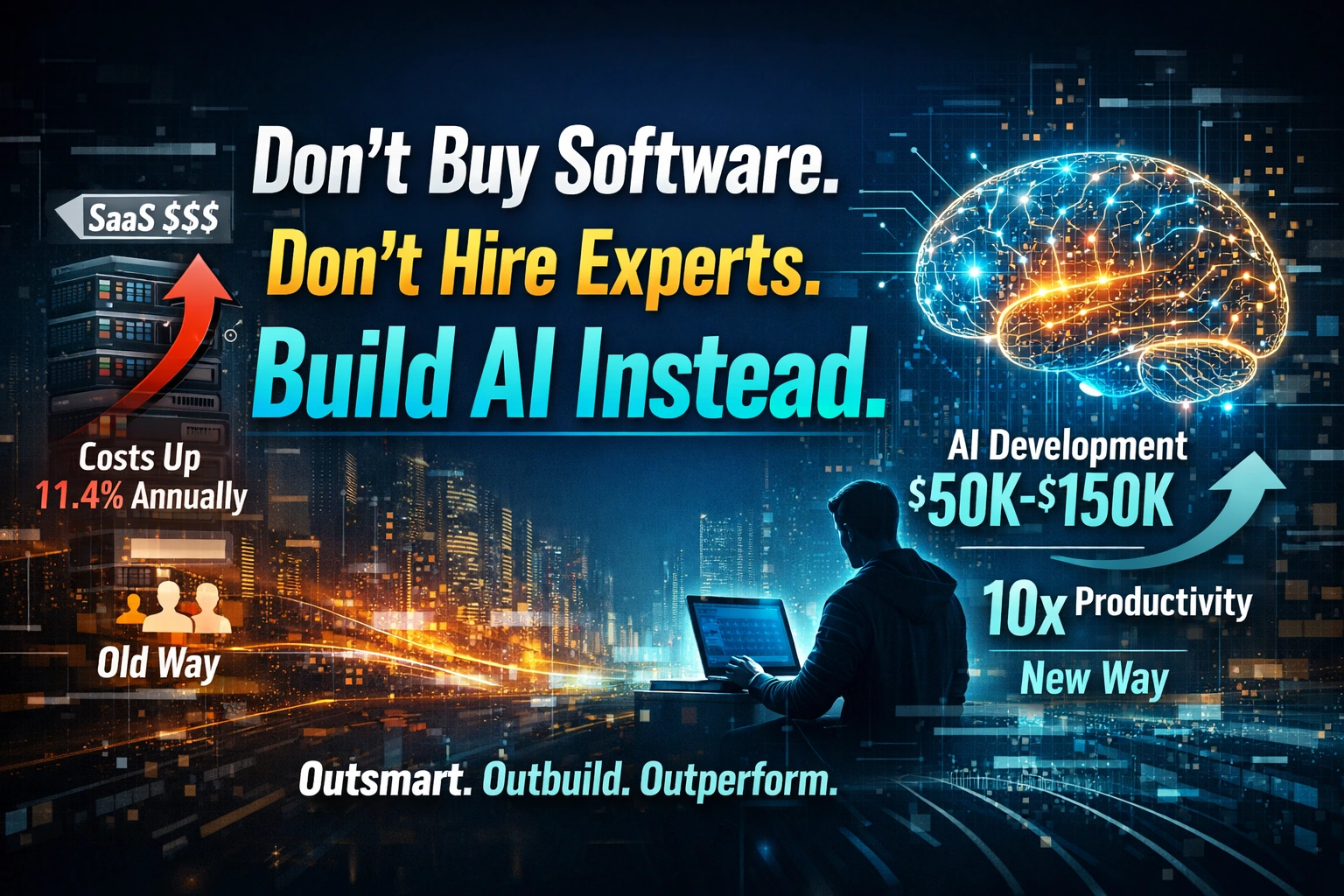
Don’t Buy Software. Don’t Hire Experts. Build AI Instead.
📘 Want the complete guide?
Learn more: Read the full eBook here →
What Karpathy and Theo proved individually has a radical organizational implication: the make-vs-buy calculus has inverted.
TL;DR
- The economics have flipped: Custom AI development that cost $500K five years ago now costs $50K-$150K. Meanwhile, SaaS costs compound at 11.4% annually (vs 2.7% inflation).
- Developer productivity is 2-10x higher with AI: GitHub Copilot shows 55.8% faster task completion; AMD measured 82% reduction in development time; Karpathy says he could be “10x more powerful.”
- Use the Cognition Ladder: Don’t compete with AI in real-time (70-85% failure rate). Build AI systems in batch contexts (40-60% cost savings) and for capabilities that were never feasible before.
The Individual Proof — And What It Reveals
In December 2025, Andrej Karpathy—former OpenAI founding member and Tesla AI chief—posted something that sent ripples through the developer community:
“I’ve never felt this much behind as a programmer. The profession is being dramatically refactored as the bits contributed by the programmer are increasingly sparse and between. I have a sense that I could be 10X more powerful if I just properly string together what has become available over the last ~year and a failure to claim the boost feels decidedly like skill issue.”
— Andrej Karpathy, December 2025
Theo Browne, running engineering teams at scale, offered concrete numbers:
“I am writing the majority of my code with AI now. I would say more than the majority, like 90%. And for the teams that I run, we’re at at least 70% AI generated code, sometimes even more. The companies that I’m advising, that I work with, that I invest in, that I talk to every day are at similar numbers.”
— Theo Browne, “You’re Falling Behind”
But here’s what most people miss: the individual developer story is the proof. The insight is what this means for organizations.
As Scott Farrell put it bluntly:
“Don’t buy software — recreate it. Don’t hire experts — write software for it.”
If one developer with AI can do what took a team before, why are organizations still paying rent to SaaS vendors and premium salaries for every domain expert?
The Economics Inversion: Why Build > Buy for Many Use Cases
The Build Side: Development Costs Have Collapsed
The evidence for AI-assisted development productivity is overwhelming:
“Developers using GitHub Copilot completed the task 55.8% faster than the control group. Specifically, the developers using GitHub Copilot took on average 1 hour and 11 minutes to complete the task, while the developers who didn’t use GitHub Copilot took on average 2 hours and 41 minutes.”
— GitHub Copilot Impact Study, arXiv
“Principled Technologies claims an 82% drop in predefined application development time.”
— AMD Study: AI for Tech Professionals
The implications for custom development costs are dramatic:
“The build-vs-buy calculation has flipped. For the first time in 15 years, SMBs can own their AI capability instead of renting it. Custom AI development that would have cost $500K five years ago now costs $50K-$150K. AI-assisted development means developers are 2-5x more productive. What took 12 months now takes 3-6 months. What took a team of 5 can be done by 2.”
— LeverageAI: The AI Paradox
This isn’t theoretical. OpenAI is using AI to build itself faster:
“OpenAI engineers are completing 70% more pull requests per week using their Codex tool. Even more mind-blowing? Their Agent Builder was developed in under six weeks, with Codex writing 80% of the PRs.”
— LinkedIn: OpenAI Internal Usage
The Buy Side: SaaS Costs Are Compounding
While build costs are dropping, buy costs are escalating dramatically:
“SaaS pricing is up by approximately 11.4% compared to the same time in 2024—a stark difference from the 2.7% average market inflation rate of G7 countries.”
— SaaStr: The Great SaaS Price Surge of 2025
Specific vendor increases paint an even starker picture:
“Aggressive Vendor Hikes: 15% — 25%. Major vendors (CRM, ERP) leveraging lock-in to force double-digit increases.”
— Medium: Build vs Buy Analysis
“Tucciarone sees the biggest hikes coming from vendors owned by private equity firms, with SaaS price increases as high as a whopping 900%.”
— CIO: SaaS Price Hikes
And your “first-year discount” is a trap:
“Renewal Discount Decay Mechanics: your Year-1 discount is framed as ‘exceptional’ or ‘first-term only.’ At renewal, pricing is recalculated against current list, not your original effective rate.”
— Enterprise SaaS Pricing Reality
| Year | List Price (Index) | Effective Discount | What You Pay |
|---|---|---|---|
| Year 1 | 100 | 40% | 60 |
| Year 3 | 108 | 28% | 78 |
| Year 5 | 117 | 18% | 96 |
| Year 7 | 126 | 10% | 113 |
Your “affordable” SaaS subscription becomes a major budget line—with no equity to show for it.
The Hidden Cost: Vendor Dependency
“Vendor lock-in ‘is driving a lot of significant increases, because organizations don’t feel they can do anything,’ says Chris Sawchuk, principal and global procurement advisory practice leader at The Hackett Group.”
— Ramp: 4 Tactics CFOs Can Use to Counter SaaS Pricing
“49% of SaaS licenses go unused. Companies with over 1,000 employees waste approximately $21 million annually on unused licenses.”
— The State of Software Costs in 2025
You’re paying more every year for software you don’t fully use, that doesn’t fit your exact needs, and that you can’t customize without begging a vendor whose roadmap serves their average customer—not you.
The Cognition Ladder: A Framework for Strategic Decisions
The economics have inverted, but that doesn’t mean you should build everything. The question is: what should you build vs buy?
The Cognition Ladder provides a systematic answer. It has three rungs, each with different time scales and success rates:
| Rung | Name | Time Scale | Build vs Buy |
|---|---|---|---|
| 1 | Don’t Compete | Seconds (real-time) | Still favor buying |
| 2 | Augment | Minutes/Hours (batch) | START HERE |
| 3 | Transcend | Overnight | THE OPPORTUNITY |
Rung 1: Don’t Compete — Where AI Still Fails
Most AI projects fail because organizations deploy AI where it’s weakest:
“70-85% of AI projects fail because companies deploy AI where it’s weakest: live, high-stakes, one-shot interactions.”
— LeverageAI: Maximising AI Cognition
In real-time, high-stakes contexts—customer service chat, live sales calls, immediate decision-making—humans still win. As Scott Farrell noted: “Don’t compete with humans — with things they are already good at.”
For Rung 1, still favor buying. SaaS vendors have optimized for these real-time contexts.
Rung 2: Augment — Where AI Wins (Start Here)
“AI wins in batch contexts: ticket queues, overnight analysis, and anywhere time flexibility exists. Batch processing typically reduces infrastructure costs by 40-60% compared to real-time systems, with savings increasing at higher volumes.”
— LeverageAI: Maximising AI Cognition
When you have latency tolerance, AI becomes extraordinarily cost-effective:
- Instead of one analyst sampling 50 transactions, AI checks every transaction
- Instead of triaging 100 tickets/day, AI triages 10,000
- Overnight batch jobs: transaction analysis, CRM scoring, anomaly detection across every row
“Once the plumbing is in, marginal cost per extra ‘thinking task’ trends toward cents instead of dollars. Companies achieving Version 2 report $3.70-$10.30 return per dollar invested.”
— LeverageAI: Maximising AI Cognition
This is where you should start building instead of buying. Custom AI systems operating in batch contexts, where marginal cognition cost approaches zero.
Rung 3: Transcend — New Capabilities (The Real Opportunity)
The real opportunity isn’t automating current work—it’s enabling work that was never feasible before:
“What if cheap cognition doesn’t just accelerate current work—but makes new work rational to attempt?”
— LeverageAI: Maximising AI Cognition
| Old Constraint | New Possibility |
|---|---|
| Strategic projects require 10 people × 3 months | Hyper sprints: thousands of AI calls overnight, human review in morning |
| Customer segmentation (too expensive to personalize) | Marketplace of One: per-customer offers, service levels, risk rules |
| Committee-think under time pressure | Systematic exploration of more possibilities than humans could ever attempt |
“McKinsey estimates that shifting from standardization to personalization represents $1 trillion in value across US industries alone. Companies leveraging AI-driven hyper-personalization are seeing 62% higher engagement and 80% better conversion rates compared to traditional approaches.”
— LeverageAI: Maximising AI Cognition
This is what SaaS vendors will never build. They optimize for standardization, for the average use case. Your specific needs—the ones that could create competitive advantage—are exactly what they can’t serve.
What to Stop Buying
Apply the Cognition Ladder to your SaaS portfolio:
Keep Buying (Rung 1 — Real-Time)
- Core infrastructure (cloud hosting, databases)
- Real-time communication (Slack, Zoom)
- Commoditized functions with no differentiation value
Question Buying (Rung 2 — Batch)
- Reporting and analytics dashboards
- CRM enrichment and scoring
- Document processing and extraction
- Internal knowledge management
- Compliance monitoring and audit
Build Instead (Rung 3 — Transcend)
- Anything that requires deep customization to your workflow
- Competitive differentiation features
- Capabilities your vendors won’t build because they serve average use cases
What to Stop Hiring For
The “don’t hire experts” insight needs qualification. Human expertise remains critical for high-stakes judgment calls (Rung 1). But for many expert functions, AI enables a different approach:
“80% of builders can now go from identifying a problem to solving it without asking for resources or support.”
— Retool: 2025 Builder Report
Traditional Model
Hire an expert → Expert applies knowledge repeatedly → Pay premium salary indefinitely
AI Model
Encode expertise in AI system → Expert trains system once → System applies expertise at scale forever
Examples:
- Legal review: Instead of hiring a compliance officer for every contract, build an AI system trained on your specific requirements
- Training: Instead of hiring consultants to deliver ISO training, build an AI system that embeds that knowledge and delivers it on-demand
- Research: Instead of hiring analysts to monitor competitors, build an AI system that does continuous intelligence gathering
As Scott Farrell framed it: “AI knows the expert advice. Your job is to work out what is valuable, dream up what a better replacement looks like, and run it through AI.”
The Capability Required
None of this works without some AI capability in-house. But you need less than you think:
“One developer with AI can now build what took a team before.”
The real requirements:
- Willingness to experiment: Try building before defaulting to buying
- Problems with latency tolerance: Use the Cognition Ladder to identify batch contexts
- Specification capability: The durable asset is your knowledge of what you need, not the code
Theo Browne’s advice for teams:
“Generally, like now more than ever, ask forgiveness not permission feels almost essential. Like if your workplace doesn’t let you use these tools, use them anyway. Either you will now be way ahead of your co-workers and be seen as an evangelist at the company or you’ll get fired for it and you have an incredible story to tell in your job interviews for other places.”
The Organizational Playbook
Raul from Ramp—who runs applied AI at a real company doing real work—provided concrete guidance:
“Give all engineers their pick of harnesses, models, background agents: Claude Code, Cursor, Devin, with closed/open models. Give your agents tools to ALL dev tooling: Linear, GitHub, Datadog, Sentry, any internal tooling. If agents are being held back because of lack of context, that’s your fault.”
— Raul @ Ramp
Key actions:
- Audit your SaaS portfolio through the Cognition Ladder lens
- Identify Rung 2 opportunities — batch contexts where building beats buying
- Run a pilot — pick one SaaS you’re paying $30K+/year for and see if you can build a replacement
- Encode expertise — for the next expert hire, first ask “could this knowledge be embedded in an AI system?”
- Build organizational AI capability — even one developer with AI tools can shift your make-vs-buy decisions
The Window Is Open — But Not Forever
The economics have inverted. Those who recognize this shift early will build competitive moats—proprietary systems, encoded expertise, capabilities that off-the-shelf SaaS can’t deliver.
Those who don’t will continue paying rent to vendors, watching costs compound, waiting for features that serve average use cases instead of their specific needs.
“The organizations getting 10x returns from AI aren’t smarter about technology. They’re smarter about deployment. They’ve stopped asking ‘where can we automate?’ and started asking ‘what becomes rational when cognition is abundant?’ That shift—from Version 1 thinking to Version 3 thinking—is the difference between AI as expensive experiment and AI as infrastructure.”
— LeverageAI: Maximising AI Cognition
What’s the first SaaS subscription you’re going to question at renewal?
Contact LeverageAI for a strategic assessment of your make-vs-buy decisions.
Discover more from Leverage AI for your business
Subscribe to get the latest posts sent to your email.