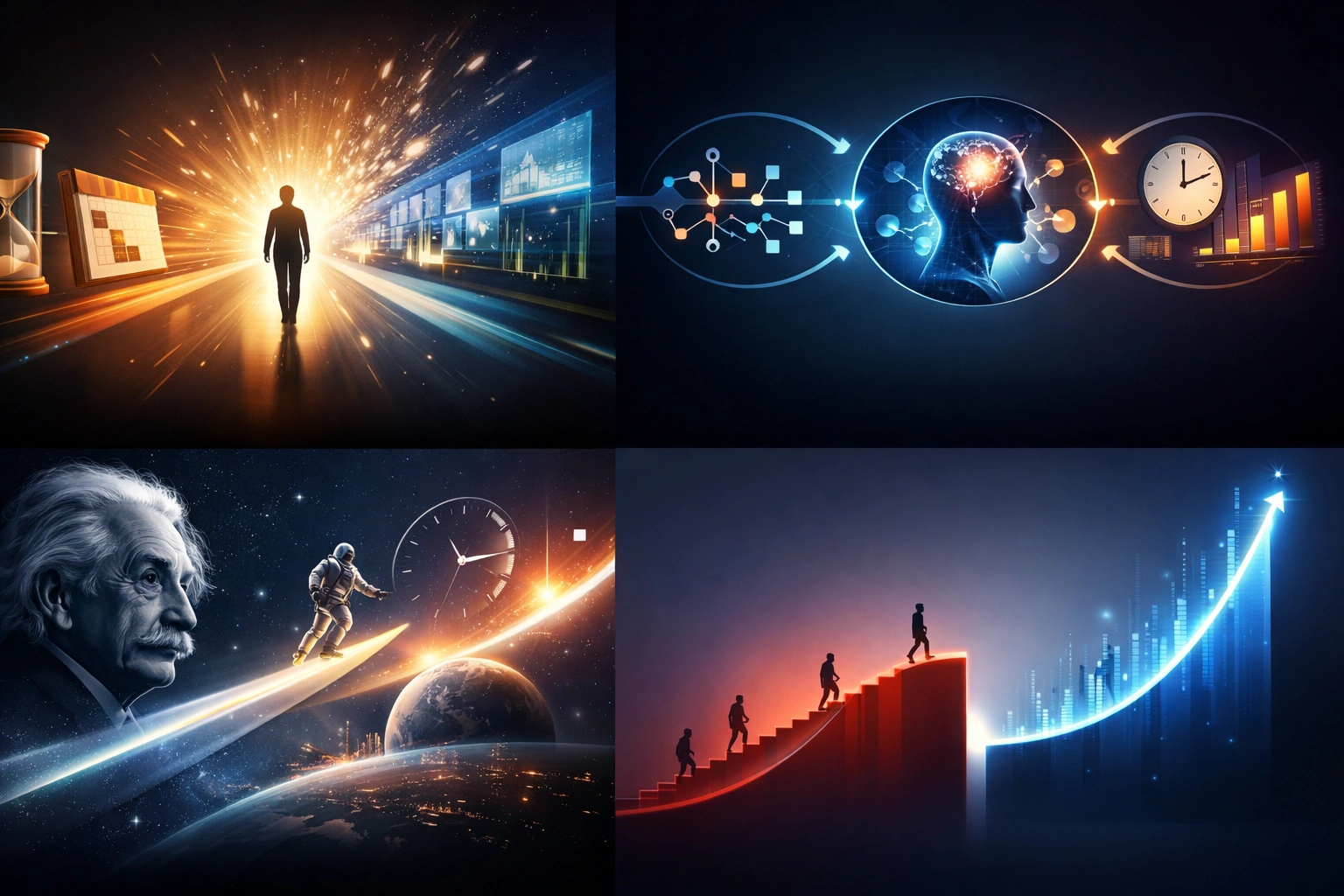
Cognitive Time Travel: Great AI is Like Precognition
Why AI doesn’t just make you faster — it gives you access to future work states you haven’t lived through yet
📘 Want the complete guide?
Learn more: Read the full eBook here →
The machine is doing work that would take you weeks. It finishes in minutes. Then it hands you the output — a deliverable that would have existed in your future, if you’d spent the calendar time to create it.
That’s not a metaphor. That’s literally what’s happening.
Most people describe AI as a “productivity tool” that makes work faster. But that framing misses what’s actually changed. Speed is a linear improvement — same dimension, compressed timeline. What AI actually provides is temporal access: the ability to receive work outputs from future states you haven’t lived through.
The difference matters. People who think “faster” plateau. People who think “temporal access” compound.
The Temporal Inversion
Consider what happens when you ask AI to research a topic, draft an analysis, or explore strategic options. The system doesn’t just type faster than you. It:
- Explores branches you’ll never manually try — running 10 approaches simultaneously instead of picking one and hoping
- Pre-computes answers to questions you haven’t asked yet — background processing that surfaces results before you know you need them
- Collapses sequential dependencies — work that required “wait for step 1, then do step 2” can happen in parallel
This is why McKinsey found that AI task completion capability is doubling every four months since 2024.1 It’s not that models are getting 10% better at typing. The temporal mechanics of work are being restructured.
of autonomous work AI systems could complete by 2027 — tasks that would take human teams weeks1
The trajectory is clear: from an “intern requiring constant supervision” to a “mid-tenure employee operating independently” to potentially “a senior executive shaping strategies.”1 That’s not efficiency. That’s temporal displacement.
Four Temporal Mechanics
If cognitive time travel isn’t metaphor, what’s the mechanism? There are four ways AI restructures the relationship between calendar time and work output:
1. Compress
AI collapses 40 hours of human work into minutes of processing. Metrigy’s research shows AI saves workers 11.8 hours per week on average — a 29.4% efficiency gain.2 Healthcare providers using ambient AI documentation save 66 minutes per day, achieving 42% reduction in documentation time.3
But compression isn’t just “faster.” It’s trading calendar time (which you can’t get back) for compute time (which costs pennies). The work that would have existed in your future — after days of effort — exists now.
2. Parallelise
Human work is fundamentally sequential. You can’t explore Option A and Option B simultaneously — you pick one, finish it, then maybe try another.
AI systems exploring parallel branches outperform sequential approaches by 90.2%.4 Research time drops by up to 90% when queries are parallelized across multiple agents instead of processed sequentially.4
“The essence of search is compression: distilling insights from a vast corpus. Subagents facilitate compression by operating in parallel with their own context windows, exploring different aspects of the question simultaneously.”
— Anthropic Engineering
This is dimensional, not linear. You’re not doing the same work faster — you’re accessing work states that sequential exploration could never reach.
3. Prefetch
Cognitive prefetching means doing the expensive thinking before the question is asked.
The Fast-Slow Split pattern illustrates this: the moment you have user context, you kick off background processing — data pulls, summarization, pattern matching — before anyone asks “what should we do about X?”5 By the time the question arrives, the answer is waiting.
Test-time compute research shows a small model with thinking time can outperform a 14x larger model with instant response.6 Accuracy jumps from 15.6% to 86.7% when models are allowed to “think” before responding.6
That’s precognition in practice: the answer exists before the question, because compute time ran ahead of calendar time.
4. Simulate
Perhaps the most powerful temporal mechanic: generating candidate futures and selecting which one to instantiate.
When you ask AI to draft three strategic approaches, or generate five versions of a proposal, or explore ten framings of a problem — you’re not just “brainstorming.” You’re simulating futures that would each take days or weeks to reach manually. Then you select one to make real.
This is precognition with agency. You see what could be before committing to what will be.
The Cognition Ladder — Rung 3: Transcend
“What takes 50 people six months can happen overnight. AI doesn’t have calendar time constraints, meeting fatigue, or coordination overhead.”7
Strategic projects requiring 10 people for 3 months become “hyper sprints”: thousands of AI calls overnight, human review in the morning.
The Einstein Parallel
This pattern isn’t new. It’s how breakthrough thinking has always worked.
Einstein’s most productive period happened at the patent office in Bern, where he conducted what he called Gedankenexperimente — thought experiments. He didn’t build physical apparatus. He imagined riding a beam of light, falling freely in an elevator, spinning disks where the rim travels faster than the center.
“I was sitting on a chair in my patent office in Bern. Suddenly a thought struck me: If a man falls freely, he would not feel his weight. I was taken aback. This simple thought experiment made a deep impression on me. This led me to the theory of gravity.”
— Albert Einstein, 1922 lecture8
Thought experiments compress implications. Instead of building apparatus and running physical tests over years, Einstein explored the logical consequences of premises in his mind. He accessed the physics that would eventually be proven — decades before the experiments existed.
AI gives everyone this capability. Frameworks compress into kernels. Kernels decompress instantly when facing problems. The thinking you did months ago — distilled into reusable patterns — applies immediately to situations you’ve never encountered.
You’re doing the thinking before the problem arrives.
Living in Fast Time vs Slow Time
Here’s the uncomfortable implication: if AI provides temporal access rather than just speed, then not using it is choosing to live in slow time while others accelerate.
The gap compounds. It’s not linear.
Organizations that established compound AI workflows six months ago now have systems that are 50%+ more cost-efficient and significantly more capable than when they started — without changing a single line of code.10 The improvement happened through accumulated learning, refined frameworks, and self-improving loops.
Each month you operate with sequential work while competitors parallel-explore, each quarter you wait while others prefetch, each year you patch while others simulate and select — the gap widens.
The person operating at 10x cognitive speed isn’t just more productive. They’re living in a different temporal reality. They get answers from futures that haven’t arrived for everyone else.
Designing for Temporal Access
If cognitive time travel is real (and the mechanics suggest it is), then workflow design shifts from “how do I go faster?” to “how do I access future work states?”
The questions become:
- Compress: What work could AI collapse from days into hours? Where am I trading calendar time when compute time would suffice?
- Parallelise: Where am I exploring sequentially when I could branch simultaneously? What future states am I leaving unexplored?
- Prefetch: What questions can I answer before they’re asked? What background processing could run while I’m focused elsewhere?
- Simulate: What futures could I generate and evaluate before committing? Where am I making decisions without seeing alternatives?
This is the difference between using AI as a speed boost and using AI as a time machine.
The Audit Question: Look at your current AI use. Are you designing for speed (same work, faster) or for temporal access (future work states, now)?
If the answer is speed, you’re leaving the real capability on the table.
Not Metaphor. Mechanics.
We keep reaching for sci-fi language — time travel, precognition, accessing the future — because the experience demands it. But the point isn’t to be evocative. The point is that the mechanics are literal.
Calendar time measures how long you wait. Compute time measures how much parallel processing occurs. AI inverts the relationship. Work that would take weeks of calendar time compresses into minutes of compute time.
The deliverable you receive — the analysis, the draft, the explored options — would have existed in your future after those weeks elapsed. Instead, it exists now.
That’s cognitive time travel. Not because it sounds cool. Because that’s what’s actually happening.
And if that’s what’s actually happening, maybe it’s time to stop designing for speed and start designing for temporal access.
Scott Farrell helps Australian mid-market leadership teams turn scattered AI experiments into governed portfolios that compound EBIT and reduce risk.
References
- McKinsey & Company. “The Agentic Organization: Contours of the Next Paradigm for the AI Era.” — “The length of tasks that AI can reliably complete doubled approximately every seven months since 2019 and every four months since 2024, reaching roughly two hours as of this writing. AI systems could potentially complete four days of work without supervision by 2027.” mckinsey.com/capabilities/people-and-organizational-performance/our-insights/the-agentic-organization-contours-of-the-next-paradigm-for-the-ai-era
- Metrigy Research via NoJitter. “AI Could Create the 3 or 4 Day Work Week If We Want It To.” — “At this point, AI is making employees 29.4% more efficient, on average… Translated into time, AI saves about 11.8 hours per week per employee.” nojitter.com/digital-workplace/ai-could-create-the-3-or-4-day-work-week-if-we-want-it-to
- OneReach.ai. “Agentic AI Adoption Rates, ROI, and Market Trends.” — “Those who used the AI agent saw a 42% reduction in documentation time, saving approximately 66 minutes per day.” onereach.ai/blog/agentic-ai-adoption-rates-roi-market-trends/
- Anthropic Engineering. “Multi-Agent Research System.” — “We found that a multi-agent system with Claude Opus 4 as the lead agent and Claude Sonnet 4 subagents outperformed single-agent Claude Opus 4 by 90.2% on our internal research eval… These changes cut research time by up to 90% for complex queries.” anthropic.com/engineering/multi-agent-research-system
- LeverageAI. “The Fast-Slow Split: Breaking the Real-Time AI Constraint.” — “The moment you have user identity—login, recognized phone number, auth token—kick off background jobs.” leverageai.com.au/the-fast-slow-split-breaking-the-real-time-ai-constraint
- Hugging Face. “What is Test-Time Compute.” — “Remarkable improvements on reasoning benchmarks like the AIME test, boosting accuracy from 15.6% to 71%, and up to 86.7% with majority voting.” huggingface.co/blog/Kseniase/testtimecompute
- LeverageAI. “Maximising AI Cognition and AI Value Creation.” — The Cognition Ladder, Rung 3: Transcend. leverageai.com.au/maximising-ai-cognition-and-ai-value-creation
- Britannica. “General Relativity.” — Einstein’s 1922 lecture describing his insight about free fall leading to the theory of gravity. britannica.com/science/relativity/General-relativity
- LeverageAI. “The AI Learning Flywheel.” — “Exponential growth (compounding): You get 1% better each day, and that 1% applies to your improved baseline. After 100 days, you’re 170% better. After a year, you’re 3,778% better.” leverageai.com.au/the-ai-learning-flywheel-10x-your-capabilities-in-6-months
- LeverageAI. “The Three Ingredients Behind Unreasonably Good AI Results.” — “Organisations that established compound AI workflows six months ago now have systems that are 50%+ more cost-efficient and significantly more capable than when they started—without changing a single line of code.” leverageai.com.au/the-three-ingredients-behind-unreasonably-good-ai-results
Discover more from Leverage AI for your business
Subscribe to get the latest posts sent to your email.