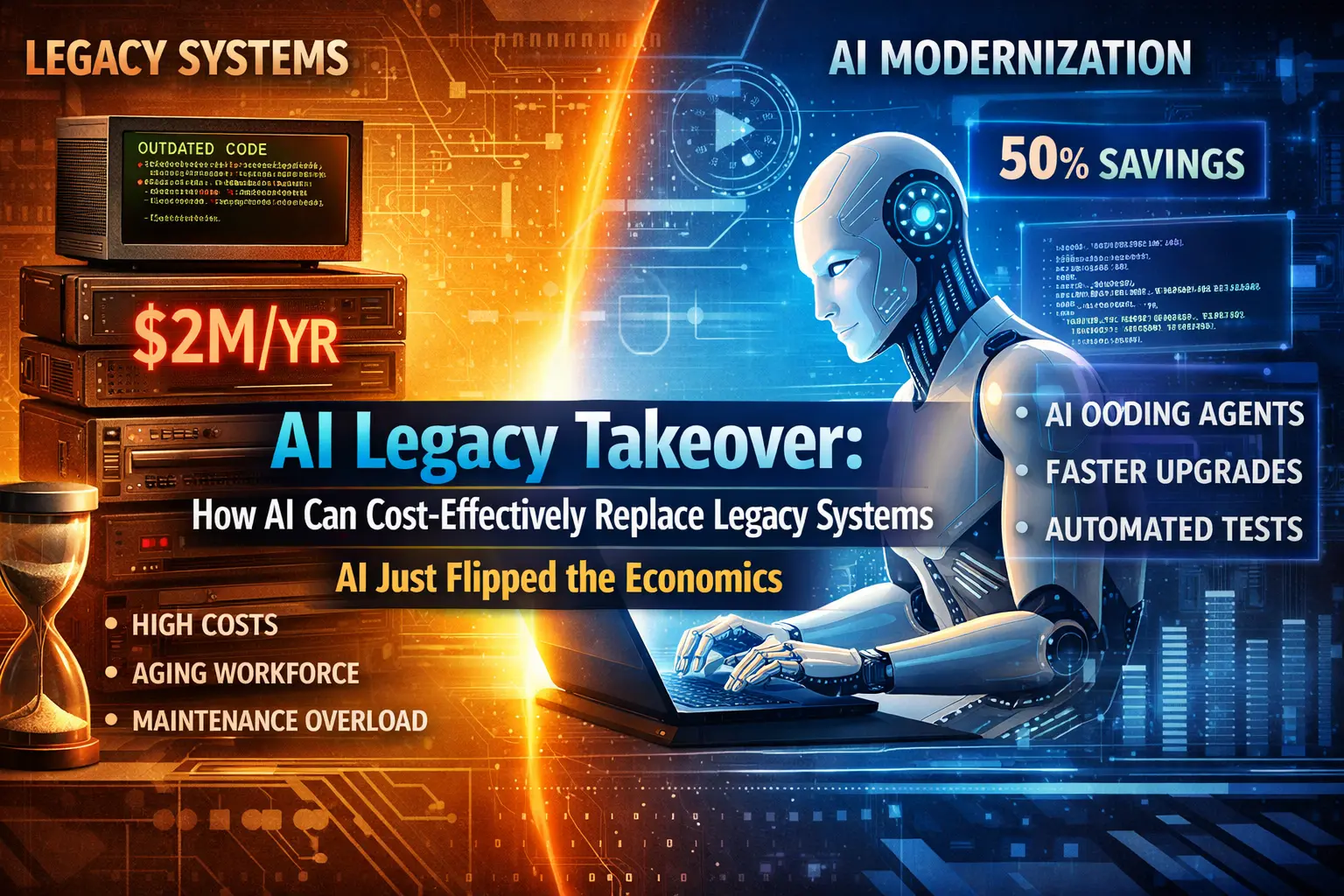
AI Legacy Takeover: How AI Can Cost-Effectively Replace Legacy Systems
Paying expensive maintenance has always been cheaper than replacement. AI just flipped the economics.
📘 Want the complete guide?
Learn more: Read the full eBook here →
Scott Farrell · leverageai.com.au · February 2026
Your legacy system already contains its own replacement specification. You just need to observe it.
That sounds provocative. But consider what you’re doing right now: paying $2 million a year1 to maintain a system nobody fully understands, built in a language nobody wants to learn, running on hardware nobody wants to support. The average COBOL programmer is 55 years old. Ten percent of them retire every year. Fewer than 2,000 new COBOL programmers graduated worldwide in 2024.2 The typical RPG programmer is pushing 70.3
You’ve been told that replacing the system would cost $5–10 million, take 12–18 months, and carry enormous risk. So you keep paying. The maintenance feels safer.
That calculation just broke.
AI coding agents now perform at 80.9% on real-world software engineering benchmarks — senior engineer territory.4 You can run dozens of them in parallel overnight. McKinsey reports that systems costing $100 million to modernise traditionally now cost less than half with generative AI.5 And LLM inference prices are falling 200x per year.6
The economics have flipped. Maintenance is now the expensive gamble. Replacement is the prudent bet.
This article describes how.
The Legacy Trap
Let’s be honest about the numbers. Nearly two-thirds of companies spend over $2 million annually maintaining legacy systems.1 In financial services, banks and insurance companies dedicate up to 75% of their IT budgets to preserving legacy infrastructure.7 Globally, legacy maintenance exceeds $2.5 trillion per year.8
And it compounds. The true cost of maintaining legacy applications increases roughly 20% annually when you account for escalating hardware costs, compliance upgrades, and system failures.9 A mid-sized firm spending $250K in Year 1 can accumulate over $1.5 million in five years.
The operational risk is just as bad. Unplanned downtime costs $9,000 per minute, and legacy system failures account for 40% of major outages.10 Legacy-dependent organisations take 2–3x longer to implement changes.10 Ninety percent of IT leaders say legacy systems hinder their ability to innovate.7
And it’s not just money. It’s risk. Your legacy system’s security model was probably designed in the late 1990s — before SOX, before GDPR, before APRA CPS 234. It predates the compliance frameworks it’s supposed to satisfy. Shared accounts, no separation of duties, audit trails in proprietary formats nobody can read, disaster recovery plans that haven’t been tested since the person who wrote them retired. An average end-of-life software image accumulates 218 new vulnerabilities every six months after support ends.23 Nearly 46% of CISA’s Known Exploited Vulnerabilities catalogue targets end-of-service software.24 You’re not just paying to maintain a system. You’re paying to maintain a compliance breach that hasn’t been discovered yet.
You know all this. You’ve lived it. The question has always been: what’s the alternative?
The traditional answer is brutal. Commission a 6-month requirements discovery. Produce a 200-page specification document. Get vendor quotes. Stare at the $5–10M price tag. Contemplate 12–18 months of build time. Then shelve the project because the risk is too high.
And the track record justifies that fear: 65% of modernisation projects exceed budget and timeline, with average cost overruns of 62%. Catastrophic failures hit 447% overruns.11
So you keep paying the maintenance tax. Year after year. While the workforce that understands these systems walks out the door.
Gartner predicts that by 2025, 60% of modernisation efforts will be delayed due to a lack of legacy skills.3 This isn’t a future risk. It’s happening now. Your “legacy whisperer” — the one person who knows why the month-end batch job does that weird thing on the third Tuesday — is thinking about retirement.
The Reframe: Your Legacy System IS the Specification
Here’s where most modernisation projects go wrong: they treat requirements as a meeting outcome.
You assemble stakeholders in a room. You ask them what the system does. They tell you what they think it does, which is different from what it actually does. The document produced is stale the day it’s finished. Half the edge cases live in one person’s head. The other half live in code nobody reads.
What if requirements weren’t a document? What if they were an empirical artefact?
Your legacy system has been running in production for years, sometimes decades. Every screen, every workflow, every validation rule, every batch job — it’s all there. The system confesses its actual rules through observed behaviour. Screenshots are the UI specification. CSV exports and config files are the data model. User workarounds are “process documentation confessed by behaviour.”
This isn’t theoretical. Task mining — recording and analysing screen-level user activity — is an established discipline. Celonis Task Mining records user activities including keystrokes, mouse clicks, and screen interactions, automatically creating analysable datasets.12 Thoughtworks has demonstrated AI agents that navigate legacy applications autonomously, “discovering user journeys by clicking through the UI and taking screenshots.”13
And here’s the critical insight: the real specification isn’t a document — it’s a test suite.
Characterisation testing (also called Golden Master testing) captures the actual behaviour of existing software and protects it against unintended changes via automated testing.14 You observe what outputs occur for a given set of inputs. Then you write a test asserting that the replacement system produces the same result. The test suite is the specification. Written specs are useful, but tests are the part you can’t argue with at 2am.
The 5-Phase Pipeline: Observe → Hypothesise → Build → Verify → Promote
Legacy replacement via AI isn’t a single heroic effort. It’s a nightly convergence loop — a scientific method machine that gets measurably closer every day.
Phase 1: OBSERVE
Record screen activity — video, keystrokes, mouse clicks, screen grabs — across multiple staff members over days or weeks. This is task mining industrialised.
Combine UI recordings with everything else you can get: data dumps, event logs, source code (if available), API traces, database schemas, report outputs. The more artefacts you capture, the richer the specification.
Overnight, vision AI decomposes recordings frame by frame to extract user flows, field mappings, screen states, business rules, and edge cases. AI tools can scan thousands of lines of legacy code and produce concise specifications of current business rules, along with test suites that capture expected outputs.15
Phase 2: HYPOTHESISE (Specify)
Auto-generate user stories, a domain model, field dictionaries, and business rule candidates from the observed data. Convert observed flows into replayable scripts with acceptance criteria.
The key here is progressive resolution: stabilise structure before committing to detail. Map the major modules and data model first (the “silhouette”). Get the architecture right. Then progressively fill in screen-level detail, validation rules, and edge cases. Don’t write prose until the skeleton passes review.
This prevents the Jenga problem — polishing detail before the structure is stable, then watching everything collapse when you discover a foundational assumption was wrong.
Phase 3: BUILD
Parallel AI coding agents implement specification deltas nightly. An army of coding bots, each working on a different module, coding up the specification changes from last night.
This is now realistic. AI coding agents achieve 80.9% on SWE-bench Verified — real-world software engineering tasks, not toy benchmarks.4 Agentic workflows boost a model from 48% (single-shot) to 95% accuracy by wrapping it in think–act–observe loops.16 Multi-agent coding swarms can condense “a month of teamwork into a single hour.”17
Critically: the code is ephemeral. The durable assets are the specification and the test harness. When the spec improves, you regenerate the code. When AI models improve, you regenerate the code. The spec is the source code; the code is the compiled binary.
You don’t trust AI to build code — because you’ve built a test harness. And honestly, we don’t really trust developers either. We test their code and review their PRs. AI is analogous to a developer you don’t trust. That’s fine. We have 50 years of engineering discipline for exactly that situation.
Phase 4: VERIFY
Run Golden Master / characterisation tests against the legacy system’s actual behaviour. Compare screenshots, reports, exports, and database effects between old and new. Flag every difference for human review.
Each morning, humans review what changed overnight. They’re not reading code — they’re reviewing diffs. “This screen now produces identical output to legacy.” “This report differs in column 7 — investigate.” “This batch job handles 98% of test cases; here are the 2% that need attention.”
After establishing a Golden Master suite, you can modernise the legacy codebase in confidence. As you add more tests further down the pyramid, you get faster feedback and become less reliant on just the Golden Master tests.18
Phase 5: PROMOTE
Ship a new beta cut daily — but only when the test harness is green. Import live data from the legacy system nightly. Have users test the replacement against real scenarios.
For production cutover, use the Strangler Fig pattern: put a façade or proxy in front of both systems, route traffic gradually to the new one, expand as confidence rises.19 This lets you deliver value early, reduce blast radius, and keep the legacy system as a fallback.
You’re not doing a big-bang cutover. You’re strangling the old system one workflow at a time while proving the new one works.
That’s the loop: Observe → Hypothesise → Build → Verify → Promote. Every night. Measurable convergence, not hopeful deadlines.
The Economics Have Flipped
Here’s the calculation that breaks the “just keep maintaining” logic:
| Old World | AI Era | |
|---|---|---|
| Maintenance cost | $2M/year (painful but predictable) | $2M/year and rising (workforce aging, security gaps widening) |
| Replacement cost | $5–10M + 12–18 months + high failure risk | Fraction of traditional cost, months not years, measurable convergence |
| Decision | Maintain (cheaper short-term) | Replace (now cheaper than maintaining) |
McKinsey confirms the shift: a transaction processing system that would have cost $100 million to modernise now costs less than half when using generative AI.5 Amazon used AI agents to modernise thousands of legacy Java applications, “completing upgrades in a fraction of the expected time.”20 Case studies show 48x development acceleration when AI-assisted development is applied to systematic builds.21
And the economics keep improving. LLM inference prices are falling at a median rate of 50x per year across benchmarks, accelerating to 200x per year since early 2024.6 The nightly coding run that costs $500 today will cost $10 next year. The specification you write today gets better code tomorrow — automatically, for free — because model improvements compound on top of a stable spec.
Meanwhile, your maintenance costs only go up. The COBOL programmer’s salary only goes up. The compliance requirements only go up. The security audit findings only go up.
If hidden costs exceed $300,000 annually, modernisation typically pays for itself within 18–24 months.11 With AI-driven replacement, that payback period compresses further.
When This Works (And When It Doesn’t)
I’m not going to pretend this works everywhere. Honesty matters more than hype.
The pipeline works well when:
- It’s an internal line-of-business application with bounded workflows
- Limited integrations (or well-documented ones)
- Modest data model complexity
- You have access to the legacy system (UI, data, logs, ideally source code)
- You can run shadow comparisons nightly (new system vs old, same inputs)
- Subject matter experts are available for morning reviews
A bounded LOB app like this? A couple of months is realistic. Not aspirational — realistic.
It’s harder (but still useful) when:
- It’s a core system with tentacles into everything
- Lots of tacit policy encoded in weird batch jobs (“we only do that once a quarter when the regulator asks”)
- Integrations are undocumented and brittle
- Data quality is — spiritually compromised
For these cases, the timeline stretches. But here’s what still holds: the approach makes uncertainty measurable quickly. After 1–2 weeks of capture and harness building, you can estimate the remaining surface area far better than traditional discovery. You know what you know. You know what you don’t know. And you have a machine that systematically chips away at the unknowns every night.
UI recordings will nail the 80% workflows fast. The legacy monster lives in the long tail: month-end jobs, batch processing, exceptions, reversals, odd permissions states, integrations nobody remembers. The nightly loop is exactly how you hunt the long tail — not through meetings, but through diffs and gap detection.
Why This Is Safer Than the Chatbot
There’s a paradox that trips up every executive I talk to. They look at “replace the legacy system” and see a massive, scary project. They look at “deploy a customer chatbot” and see a quick, safe win.
The risk geometry is inverted.22
The chatbot is customer-facing, real-time, operating in an infinite input space, under latency constraints, with brand and compliance exposure. It’s the boss fight.
Legacy replacement is internal, batch-processed, producing reviewable artefacts, protected by a test harness, with rollback capability. Every output is inspectable. Every nightly build either passes the harness or it doesn’t. Humans review every morning. Nothing hits production without gates.
This is AI staying in its lane: slow cognition, parallelism, artefact generation, overnight processing. It sits squarely on Rung 2 and Rung 3 of the Cognition Ladder — augmenting and transcending, not competing with humans in real time. And that’s exactly where AI delivers compounding returns instead of compounding headaches.
The Real Specification Isn’t a Document
Legacy modernisation has been stuck for decades because everyone keeps trying to write the specification before building the system. The specification comes out of meetings. It’s stale before the ink dries. It misses what people actually do versus what they say they do. And it costs months of calendar time and hundreds of thousands of dollars to produce.
The pipeline I’ve described treats the specification differently. It’s not a document — it’s a test suite. It’s not produced in meetings — it’s observed from reality. It’s not a one-time deliverable — it evolves every night as the system converges.
Requirements as empirical artefacts. Nightly convergence instead of waterfall deadlines. Code that regenerates automatically as models improve. A test harness that removes the need for trust.
Legacy modernisation isn’t the gamble. It’s the gamble not to do it. Your maintenance costs are compounding. Your workforce is retiring. Your competitors are moving. And AI just made the “unthinkable” project the most economically rational thing on your roadmap.
If you’re sitting on a legacy system nobody wants to maintain, let’s talk about what 90 days could look like.
scott@leverageai.com.au · leverageai.com.au
References
- [1]RTInsights. “Overcoming the Hidden Costs of Legacy Systems.” rtinsights.com/modernizing-for-growth-overcoming-the-hidden-costs-of-legacy-systems/ — “Nearly two-thirds of companies spend over $2 million annually maintaining legacy systems”
- [2]Perimattic. “Cost of Maintaining Legacy Systems in 2026.” perimattic.com/cost-of-maintaining-legacy-systems/ — “The average COBOL programmer is now 55 years old, with 10% of the workforce retiring annually, and fewer than 2,000 COBOL programmers graduated worldwide in 2024”
- [3]Techolution. “The Silent Workforce Crisis Making Legacy Systems a Ticking Time Bomb.” techolution.com/blog/the-silent-workforce-crisis-making-legacy-systems-a-ticking-time-bomb/ — “Gartner predicts that by 2025, 60% of modernization efforts will be delayed due to a lack of legacy skills”
- [4]Vertu. “Claude Opus 4.5 vs GPT-5.2 Codex: Head-to-Head Coding Benchmark Comparison.” vertu.com/lifestyle/claude-opus-4-5-vs-gpt-5-2-codex-head-to-head-coding-benchmark-comparison/ — “Claude Opus 4.5 leads on the critical SWE-bench Verified benchmark with 80.9% versus 80.0%, making it the first AI model to exceed 80% on this real-world coding test”
- [5]McKinsey & Company. “AI for IT Modernization: Faster, Cheaper, and Better.” mckinsey.com/capabilities/quantumblack/our-insights/ai-for-it-modernization-faster-cheaper-and-better — “A transaction processing system that would have cost $100 million to modernize now costs less than half when using gen AI”
- [6]Swfte AI. “AI API Pricing Trends 2026.” swfte.com/blog/ai-api-pricing-trends-2026 — “LLM inference prices have fallen between 9x to 900x per year depending on the benchmark. The median decline is 50x per year, accelerating to 200x per year after January 2024”
- [7]Sunset Point Software. “The Legacy Paradox.” sunsetpointsoftware.com/post/the-legacy-paradox-why-people-know-they-need-to-get-rid-of-legacy-systems-but-just-can-t-bring-the — “Banks and insurance companies spend up to 75% of IT budgets preserving legacy systems” and “90% of IT decision-makers believe legacy systems are hindering innovation”
- [8]V2Connect. “The Cost of Delay in Legacy System Modernization.” v2connect.v2soft.com/the-cost-of-delay-what-happens-when-legacy-system-modernization-is-ignored/ — “Global legacy maintenance costs exceed $2.5 trillion annually”
- [9]Profound Logic. “True Cost of Maintaining Legacy Applications.” profoundlogic.com/true-cost-maintaining-legacy-applications-industry-analysis/ — “The true cost of maintaining outdated applications compounds 20% annually”
- [10]Ponemon Institute, via LinkedIn. “The Cost of Legacy Systems.” linkedin.com/pulse/cost-legacy-systems-how-outdated-holds-companies-back-andre-occec — “Unplanned downtime costs $9,000 per minute, with legacy system failures accounting for 40% of major outages” and “Legacy-dependent organizations take 2-3x longer to implement changes”
- [11]Hexacorp. “Legacy System Modernization Risk Guide.” hexacorp.com/legacy-system-modernization-risk-guide/ — “65% of modernization projects exceed budget and timeline, with average cost overruns reaching 62% and catastrophic failures experiencing overruns of 447%”
- [12]Celonis. “Task Mining Solutions.” celonis.com/process-mining/what-is-task-mining/ — “Celonis Task Mining collects data by recording user activities through an app called workforce productivity, automatically creating a dataset with screen records”
- [13]Thoughtworks. “Blackbox Reverse Engineering: AI Rebuild Application Without Accessing Code.” thoughtworks.com/en-us/insights/blog/generative-ai/blackbox-reverse-engineering-ai-rebuild-application-without-accessing-code — “AI agents with access to tools like Playwright MCP are sent to navigate applications, discovering user journeys by clicking through the UI and taking screenshots”
- [14]Wikipedia. “Characterization Test.” en.wikipedia.org/wiki/Characterization_test — “Characterisation testing is a means to describe the actual behavior of an existing piece of software and protect existing behavior of legacy code against unintended changes via automated testing”
- [15]Evermethod. “Modernizing Legacy Systems with GenAI.” evermethod.com/blog/modernizing-legacy-systems-with-generative-ai-solutions — “AI tools can scan thousands of lines of legacy code and produce a concise specification of current business rules, along with a suite of unit tests”
- [16]Andrew Ng. “Agentic Workflows.” linkedin.com/posts/andrewyng_one-agent-for-many-worlds-cross-species-activity-7179159130325078016-_oXr — “GPT-3.5 (zero shot) was 48.1% correct, but when wrapped in an agent loop, GPT-3.5 achieved up to 95.1%”
- [17]Zen van Riel. “Claude Code Swarms: Multi-Agent Orchestration.” zenvanriel.nl/ai-engineer-blog/claude-code-swarms-multi-agent-orchestration/ — “Tens of instances of Claude Code in parallel being orchestrated to work on specifications… condensing a month of teamwork into a single hour”
- [18]Codurance. “How to Test Legacy Software When Modernising.” codurance.com/publications/how-to-test-legacy-software-when-modernising — “After establishing a Golden Master suite, you can modernise the legacy codebase in confidence”
- [19]Martin Fowler. “Strangler Fig Application.” martinfowler.com/bliki/StranglerFigApplication.html — “The pattern was coined to avoid risky ‘big bang’ system rewrites”
- [20]LowTouch.ai. “AI Adoption 2025 vs 2026.” lowtouch.ai/ai-adoption-2025-vs-2026/ — “Amazon used Amazon Q Developer to coordinate agents that modernized thousands of legacy Java applications, completing upgrades in a fraction of the expected time”
- [21]ISBSG. “Impact of AI-Assisted Development on Productivity and Delivery Speed.” isbsg.org/wp-content/uploads/2026/02/ — “One case study accelerated AI model development by 48x, reducing the time to build and deploy models from months to days”
- [22]LeverageAI. “The Simplicity Inversion: Why Your Easy AI Project Is Actually the Hardest.” leverageai.com.au/the-simplicity-inversion-why-your-easy-ai-project-is-actually-the-hardest/ — “What executives perceive as ‘simple’ AI (customer chatbots) is actually hardest; what seems ‘complex’ (internal developer tools) is easiest”
- [23]HeroDevs. “How Outdated Systems Are Fuelling Modern Cyber Attacks.” herodevs.com/blog-posts/how-outdated-systems-and-legacy-software-are-fueling-modern-cyber-attacks — “An average end-of-life software image accumulates 218 new vulnerabilities every six months after support ends”
- [24]Automox. “Unpatched Vulnerabilities Make Legacy Systems Easy Prey.” automox.com/blog/unpatched-vulnerabilities-make-legacy-systems-easy-prey — “Nearly 46% of CISA’s Known Exploited Vulnerabilities catalogue are linked to end-of-service software”
Scott Farrell is an AI strategy advisor and solutions architect helping Australian mid-market companies ($20M–$500M) turn AI spend into compounding returns. He has published 26+ articles and 15+ ebooks on AI deployment, governance, and organisational transformation. leverageai.com.au
Discover more from Leverage AI for your business
Subscribe to get the latest posts sent to your email.