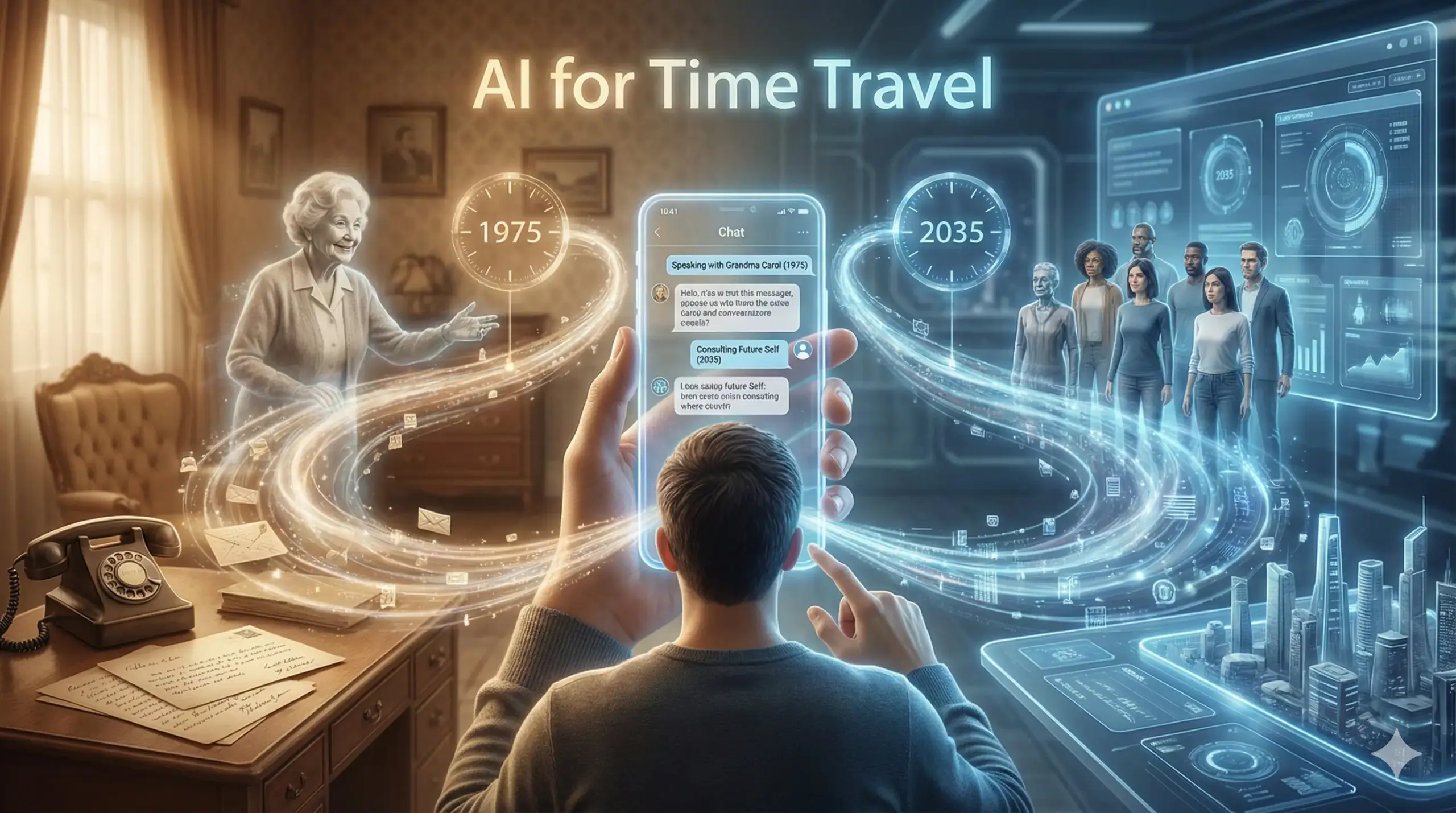
AI for Time Travel: How AI Enables Conversations Across Time
📘 Want the complete guide?
Learn more: Read the full eBook here →
TL;DR:
- AI enables “time travel” conversations with people we can’t normally reach: the dead, past versions of people, future selves, simulated personas
- Late 2025 is the unlock: video generation crossed the photorealism threshold (73% can’t tell it’s AI), persona modeling dropped to $140-$1,400
- The pattern is systematic and already deployed: sales training, marketing, healthcare, memorial services all use “Time-Shifted Proxies”
I Called My Grandparents in the 1970s
My brother is into genealogy. He found an old letter my aunt Carol had written to her parents back in the 1970s. I took that letter and made two things from it.
First, a “radio play” version—a produced audio piece where you hear Carol calling her father. It’s the 1970s. He’s just… Dad.
Radio play: A call to Carol from her father, set in the 1970s
Second, an interactive phone version. You can actually ring my grandparents—or ring Carol herself—and have a real conversation. You’re not listening to a recording. You’re in the 1970s, talking to them.
Same source material. Two completely different experiences.
My brother was gobsmacked. Not because it sounded realistic—but because he suddenly saw his genealogy research differently. All those letters and documents? They didn’t have to stay as archives. They could become conversations.
That’s when I realized I’d stumbled into a design space much larger than genealogy.
Five Ideas That Seem Unrelated
Consider these applications:
1. The AI Partner as Future Matchmaker
Users fall in love with an AI partner that’s gradually building a profile of who they’d actually be compatible with. The system pairs them with a real person whose patterns match. The AI is a “placeholder for your future partner.”
2. Virtual Scott After Death
An app that captures your voice, writing, and conversations. When you die, it becomes a conversational model your family can talk to—”a compressed explainer of how Scott would likely react, trained on 40 years of receipts.”
3. Future-You Holiday Testimonials
Before booking a holiday, you receive a video of “future you, 3 months after the trip,” telling present-you how much you loved it. The experience previewed before it happens.
“I can’t believe how much the kids loved swimming with the fish on the reef… and watching them chase the kangaroos.” — Kevin, reflecting on a trip that hasn’t happened yet.
4. AI Customers for Sales Training
Twelve different AI personas, each representing a different client type with hidden problems. Staff ring the AIs to practice. Real conversations with synthetic customers.
5. Rehearsing Difficult Conversations
Practice asking your boss for a raise. Prepare for a hard conversation with your partner. The AI plays the other person so you can iterate before stakes are real.
What’s the common thread?
Every single one is a conversation that can’t normally happen—blocked by death, time, absence, or risk.
And every single one solves it the same way: build an AI stand-in, frame it in the right time direction, present it in an emotionally accessible medium.
The Time-Shifted Proxy Pattern
Step 1: Identify an impossible conversation—someone you can’t reach
Step 2: Choose time direction—past (“what happened”), future (“how did this turn out”), or parallel (“what would someone like this say”)
Step 3: Build the AI stand-in—using available data (letters, transcripts, personas)
Step 4: Translate the medium—from static archives to calls, video, or chat
Step 5: Attach a purpose—training, marketing, decision support, grief, rehearsal
Once you see this as a reusable operator, you can point it anywhere.
Why Late 2025 Is the Inflection Point
Three technical barriers fell almost simultaneously:
1. Video Generation Crossed the Photorealism Threshold
of viewers can’t distinguish high-quality AI video from traditional footage in blind tests. Q3 2025 marked “the August breakthrough moment.”
“Many shots pass the visual Turing test, in which most people would not be able to distinguish that it’s completely synthetic.”
— Filmmaker Paul Trillo on Google’s Veo 2
2. Persona Modeling Became Commercially Accessible
Digital replicas now cost $700-$1,400, dropping to $140 via apps. DeepBrain AI creates avatars from a single photo and 10-second audio clip.
“Some replicas are 90-95% indistinguishable from the real person.”
— Sensay founder
3. Parasocial AI Went Mainstream
- 220 million cumulative downloads of AI companion apps
- 72% of U.S. teens have tried an AI companion
- 92 minutes/day average usage on Character.AI
- 85%+ of Replika users report emotional connections
People already want AI for relationships, not just productivity.
The Business Applications Are Already Deployed
Sales Training: AI-simulated customers deliver 340% better conversion improvement vs. traditional methods. Oracle saw opportunities per rep rise from 2.78 to 6.02/month.
Medical Education: 80% of Mayo Clinic trainees want to continue using AI patient simulation for difficult conversations.
Marketing: Video testimonials boost conversions by 80%. Customers remember 95% of video vs. 10% of text.
Memorial Services: StoryFile has 5,000+ profiles. Super Brain created 1,000+ digital replicas since March 2023. China’s virtual human market: $6.7B by 2025.
Decision Support: MIT’s “Future You” showed decreased anxiety and stronger connection to future self across 344 participants.
The Design Space Matrix
Mix and match across three axes:
Time Direction:
- Past: “What really happened?” / “Talk to grandma in 1975”
- Future: “How did this turn out?” / “Future-you loved the trip”
- Parallel: “What would someone like this say?” / “Typical angry customer”
Role to Simulate:
- Self (past, future, alternate)
- Family (deceased, young, historical)
- Customer (churned, happy, angry, future)
- Colleague (boss, team, report)
- Stakeholder (regulator, investor, partner)
Medium Level:
- Text chat (lowest friction)
- Voice call (high intimacy)
- Video (highest emotional resonance)
Every cell in that grid is a potential product. The question: which impossible conversation would unlock the most value in your domain?
The Core Mechanism: Media Translation
Here’s the insight underneath all of this:
The constraint was never technical—it was media format.
The archive already exists. Letters from grandma. CRM notes. Research on what makes holidays memorable. The raw material was always there.
AI enables translation: converting high-friction, emotionally distant archives into low-friction, emotionally rich interactions.
“Old letters are a bit much to sit and read. But an interactive phone call—when you can talk to them, ask stuff, and they inject info from the letters? That’s different.”
Humans are lazy mammals with big feelings. We want the meaning, not the microfiche.
AI doesn’t create new information—it makes existing information consumable in the form our brains actually want.
Practical Next Steps
- Audit for impossible conversations. Who do you wish your team or customers could talk to—but can’t?
- Identify existing data traces. CRM notes, support tickets, expert recordings, historical documents.
- Choose the right medium. Text for exploration. Voice for intimacy. Video for impact.
- Prototype small. A single “call with the churned customer” can prove the concept.
- Measure emotional resonance. The KPI isn’t task completion—it’s whether people felt they really had that conversation.
Back to Grandma
My grandmother died before I was old enough to have adult conversations with her. The AI didn’t bring her back. It let me step into 1975 and have the conversation that letter implied. Not asking about the past—but being in the past with her.
That’s what Time-Shifted Proxies actually are. Not resurrection. Not simulation. Translation.
Turning static archives into living interactions. Turning time-locked people into ongoing relationships. Turning the conversations we can’t have into conversations we can.
The technology is ready. The applications are emerging across every domain.
What conversation across time will you enable first?
Discover more from Leverage AI for your business
Subscribe to get the latest posts sent to your email.