An AI That Sees Your
Entire Dental Practice
Reviews it. Protects it. Coordinates it. Acts on it.
Every night. While you sleep.
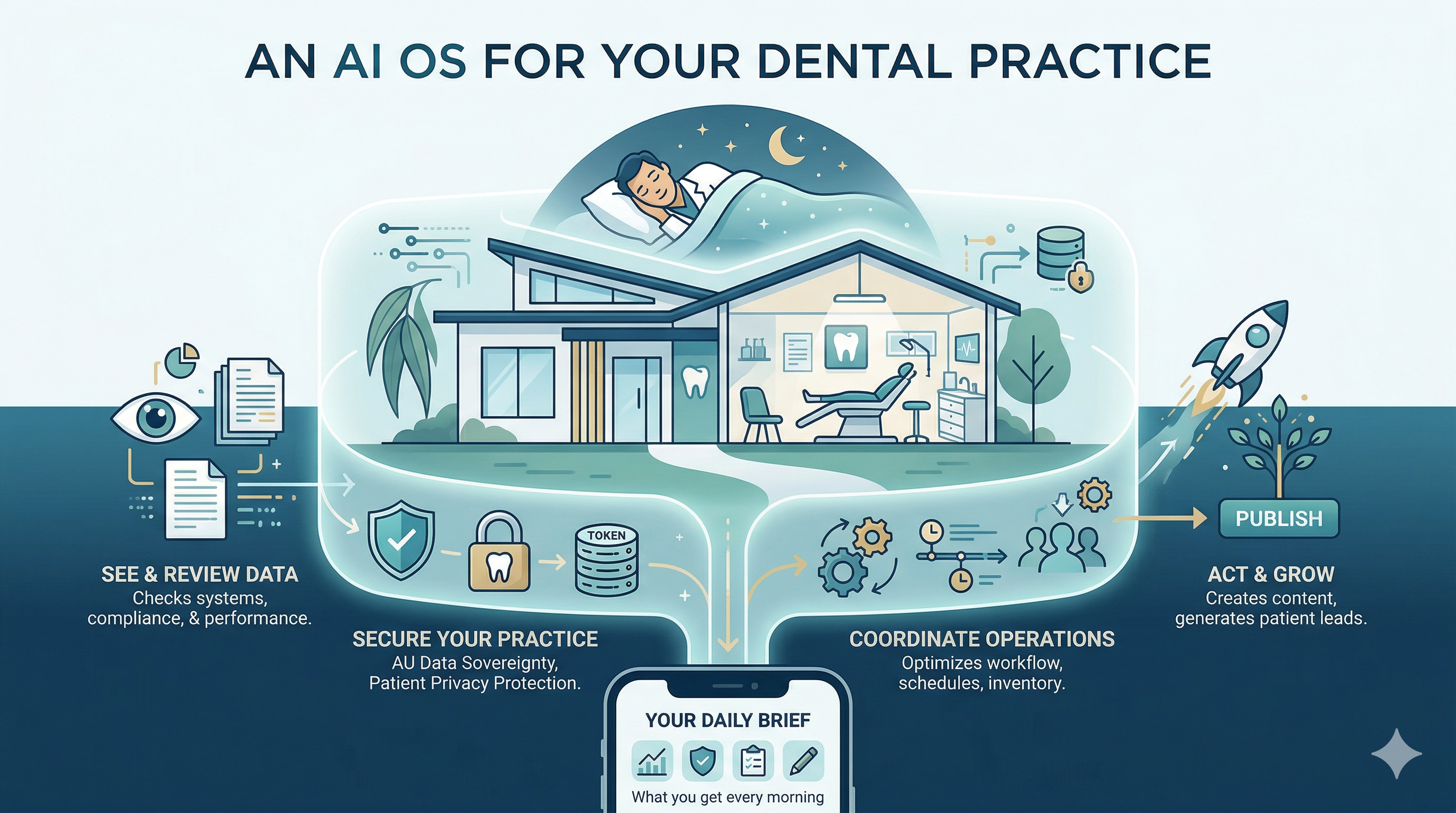
Reviews it. Protects it. Coordinates it. Acts on it.
Every night. While you sleep.
Not a tool. Not a dashboard. An operating system that wraps around everything you do — reads it, protects it, coordinates it, and takes action.
Reads everything, every night
Patient management system. Accounting. YouTube analytics for every video. Every page of your website. Every blog post. Instagram, Facebook, TikTok engagement. Staff schedules. Dental supply inventory. The homepage rendered with a real browser to see what patients actually see. It reads all of it, converts it to a format it can reason about, and holds the full picture.
12-point infrastructure audit. PII/PHI scanner (Medicare, TFN, IHI — Australian identifiers with checksum validation). Port lockdown. Firewall. Backup verification. Patient data tokenized and never offshore. Findings redacted before they reach the AI.
Every page, blog post, and YouTube transcript scanned against AHPRA advertising guidelines. Testimonials flagged. Before/after photos checked. Outcome claims caught. Privacy Act reviewed. The compliance consultant that visits every night, not once a year.
Cross-channel intelligence. Which content works on which platform. Which service pages drive bookings. Which videos convert subscribers. Where the gaps are. Where channels can amplify each other. Connections no single employee could make.
Advisory council argues priorities. PMO tracks progress. Boards manage work.
Seven C-suite personas read the analysis and argue about what to do. Insights become recommendations. Recommendations become project cards. The PMO tracks velocity and flags blockers. Stale cards get surfaced. Missing work gets proposed. Priorities shift based on data, not gut feel.
Create content. Publish. Connect systems. Send comms.
Writes blog posts, scripts YouTube videos, creates social media content, generates images and thumbnails. Publishes to WordPress, YouTube, Instagram, TikTok. Drafts patient communications. Manages inventory alerts. Each piece compliance-checked before it goes live. Each action tracked on the board from backlog to done.
This isn't generic AI with dental examples. It's built around the specific regulatory, clinical, and operational reality of running a dental practice in Australia.
Patient testimonials are prohibited. Before/after photos need specific disclaimers. You can't reply "thank you" to a Google review that mentions treatment. No influencer promotions. No outcome guarantees.
Most practices don't know they're non-compliant. The system checks every piece of public content, every night. First run found 8 RED findings the practice didn't know about — including patient testimonials embedded via a Google review widget.
Health service providers are explicitly excluded from the small business exemption. All 13 Australian Privacy Principles apply. Penalties up to $50 million. New statutory tort (June 2025) means patients can sue directly.
NSW HRIP Act adds another layer. 7-year record retention for adults, until age 25 for minors. Mandatory breach notification within 30 days. Health sector is #1 for reported breaches nationally.
VPS in Sydney. Patient data tokenized at entry — the AI never sees real names, Medicare numbers, or DOBs. Only verified exit boundaries (your screen, Carestack, patient SMS) see the real data. Everything else — reports, logs, AI memory, project boards — stays tokenized. The scanner catches leaks without escalating them.
Carestack integration for appointments, treatment plans, recalls. Xero/MYOB for practice finances. Dental supply inventory and reorder alerts. Staff scheduling. Daily practice brief before your first patient. Patient comms that pass AHPRA compliance. Emergency dental page monitoring. Oral-systemic content strategy based on what actually converts patients.
You open your phone over coffee. Everything you need to know.
Which videos are performing. Which pages are ranking. Which posts got engagement. Where the gaps are. Cross-channel insights connecting YouTube to website to blog to social — things no single tool shows you.
AHPRA compliance breaches you didn't know about. SEO damage from duplicate pages. COVID-era content still indexed. Security vulnerabilities. Patient data exposure risks. Caught overnight, not during an audit.
Seven senior personas argued about your business overnight. The CEO synthesised their views into ranked priorities. Not a list of metrics — a strategic recommendation of what to do today, this week, this month. With project cards already created.
Blog posts drafted. Social media posts queued. Video thumbnails generated. All compliance-checked against AHPRA guidelines. Waiting in the approvals board for you to drag to "approved" — or leave a comment and it revises.
Security review passed. PII scanner found nothing (or found something and already redacted it). All services locked to VPN. Backups verified. No patient data offshore. Green light.
Today's appointments. Pending treatment plans. Overdue recalls. Inventory alerts. Yesterday's social media performance. Compliance flags. Everything a practice owner needs before the first patient walks in.
The project boards are the collaboration surface between the AI and your team. This is how work gets proposed, reviewed, approved, executed, and tracked.
The AI populates them with insights and recommendations. You manage them — drag cards, reprioritise, add your own ideas, approve or reject. The PMO reviews them nightly for velocity. The advisory council reviews them for strategic alignment. Nothing falls through the cracks.
YouTube video ideas, Instagram reels, TikTok hooks. Each card has a brief: topic, keywords, target audience, format. Sourced from analytics insights and council recommendations. AI picks up the top card each morning and creates the content.
The editorial calendar. Topics from SEO gaps, patient FAQs, cross-channel insights. The system knows "oral-systemic health" is your best-performing topic across all channels — blog cards reflect that.
Everything non-content: system integrations, staff processes, inventory issues, operational improvements. The COO persona proposes these. The PMO tracks them.
The human checkpoint. Drafted blog post needs sign-off? Social post touching a sensitive topic? Website change affecting patient-facing content? It lands here. Quick scroll on your phone, drag to "approved", the AI publishes. Or leave a comment — it revises and resubmits.
Things the AI can't decide alone. AHPRA compliance finding that needs a business decision. Budget question from the CFO. Operational issue that needs human judgement. They don't get buried in a report — they surface as cards with context and recommended actions.
Council insight → card appears on the right board with a brief, priority, and context
Drag to approve, reprioritise, add notes, reject, or add your own ideas
Picks up approved items, creates content, compliance-checks, publishes, moves to done
PMO reviews velocity. Council reviews outcomes. Stale cards flagged. New cards proposed. Nightly.
You can also just talk to the AI. "Create a card for a NightLase landing page." "What's stuck in backlog?" "Draft me a blog post about implants for diabetic patients — I had inspiration from a case today." It has access to every board, every report, every data source. It has the context to act intelligently because it reads everything every night.
The layers run every night. The boards manage the work. But the real shift happens when you sit down and talk to it.
You're talking to something that has already read every system, already thought about what matters, and can act on anything you decide — right now, in the conversation.
You don't explain what's happening on YouTube — it watched last night. You don't summarise your week — it read every system. The conversation starts where you are, not where it needs to catch up.
WordPress, Carestack, Xero, email, social platforms, project boards — it doesn't just read them, it works inside them. Creates drafts, publishes posts, sends comms, updates cards, schedules tasks.
"Draft a blog post every day" — one sentence from you becomes a permanent workflow: research, write, compliance-check, create draft, notify you for approval. Across your systems, every time, without being asked again.
Fix the same thing three times? Tell it to make that a scheduled task. It builds its own automations from your corrections.
Your preferences, your processes, your corrections — they stick. It doesn't ask the same question twice. Six months in, it knows your practice better than any employee you could hire.
Early days, you're firefighting — fixing compliance issues, catching up on content. Month three, the fires are out and processes run on autopilot. You're reviewing strategy, not chasing tasks.
Most dentist-owners work on the business after the last patient leaves. Quick check-ins from the chair. Deeper strategy sessions at the desk. Your AI is ready for both.
"Someone asked about NightLase pricing — please review and draft a reply"
"Add 'staff birthday program' to the ideas board"
"Approve the blog post about implants"
"What needs my attention today?"
"Help me review our social media strategy for Q2"
"The CEO council recommended we fix the emergency dental page — how do we action that?"
"Let's plan out social media for the next month"
Compliance breaches to fix. Content gaps to fill. Duplicate pages to merge. You're making decisions and the AI is executing them fast. The backlog is clearing.
Blog posts draft themselves daily. Social content flows from the boards. Compliance is clean. You're reviewing and approving, not creating. The fires are out.
You're reading the CEO council summary and making strategic calls. "Let's expand into sleep dentistry content." "Start tracking referral sources." Higher-level decisions, not daily tasks.
"You're not prompting a chatbot. You're talking to someone who sees your entire practice, works inside your systems, and turns every decision into a process it never forgets."
Seven senior executives who read every report, every data source, every board — and argue about what matters most. This is what brings it all together.
They don't hedge. They state what they see, what's wrong, and what they want done. They advocate for their department and push back on each other. The CEO synthesises into ranked priorities. Insights become cards. Cards become actions. Actions become results. Results get reviewed tomorrow night.
The Marketing Manager spots a -25% YouTube view decline and a NightLase revenue leak. The CIO confirms security is green but flags a version mismatch. The COO checks that staff comms are flowing and appointments are on track. The CFO notes the platform costs $13/month and questions whether the content creation investment is paying off. The PMO flags that 26 cards are sitting in backlog. The HR Manager raises staff training needs for the new systems. The CEO reads all six, weighs the trade-offs, and ranks: Emergency Dental page rewrite first. NightLase landing page second. Content publishing cadence third.
Real findings from the actual reports. Not hypotheticals.
Google review widget embedding named patients describing clinical outcomes. Practice didn't know this was a breach.
NightLase video with 43% retention. Warm leads with nowhere to book. Marketing Manager created the card.
Highest-traffic service page. Content doesn't match the topic. CEO ranked it as the #1 priority rewrite.
Implants x2, whitening x2, crowns x2. Splitting authority for the highest-value commercial keywords.
Three independent systems flagged them for three different reasons. Same conclusion: remove.
Oral-systemic: best YouTube series, best blog cluster, best service page. None link to each other.
Not by policy. By architecture. The same principle as Blu-ray HDCP — encrypted data flows through every component, and only a verified endpoint sees the real thing.
Spots oral-systemic content performs best. Creates a blog post. Links it to the service page. Embeds the YouTube video. Cross-links the video description back.
Blog starts ranking. YouTube views bump. Service page SEO improves. Council notes the improvement, proposes the follow-up: "diabetes and gum disease."
Follow-up published. Instagram carousel extracted from blog. TikTok hook from YouTube's best moment. Content cluster grows across every channel.
Oral-systemic drives 40% of organic traffic. Marketing proposes a series. PMO creates 8 cards. CFO notes these leads have the lowest acquisition cost.
A short video walkthrough and an audio explainer of the nightly AI council.
Generated via NotebookLM — a podcast-style overview of how the advisory council works.